Mud does not announce itself. A site that looks manageable in the morning becomes a serious operational problem after an afternoon of rain. Equipment that crossed the same ground yesterday without issue is stuck up to the axle today.
Mud mats for heavy equipment solve the access problem that wet and saturated ground creates — by giving machines a stable, load-rated surface to operate on regardless of what the ground below looks like. This guide covers when mud mats are essential, how to build a mud access system that holds up, and why the right material makes the difference between keeping a job moving and losing a full day to equipment recovery.
Why Soft Ground Fails Under Heavy Equipment
Soil bearing capacity drops fast when wet
Dry, compacted soil can support significant equipment loads. The same soil after rainfall or snowmelt is a different material. As water fills the pore space between soil particles, the friction that gives soil its load-bearing capacity disappears. Saturated clay soil can lose 70 to 80 percent of its dry bearing capacity. Equipment that moved freely on Monday can sink to the axle on Tuesday.
Equipment weight concentrates through small contact areas
A 10,000-pound skid steer distributes its weight through four tires with a combined contact area of perhaps 600 square inches. That concentrated pressure — about 17 pounds per square inch — easily exceeds soft ground’s capacity to resist. The ground fails, the tire sinks, and traction disappears.
Getting stuck is exponentially more expensive than preventing it
Recovering a stuck machine — pulling it with another machine, using recovery boards and winches, or waiting for the ground to dry — costs hours of crew time and equipment downtime. One recovery event typically costs more in lost productivity than a full set of mud mats costs to purchase. One stuck machine per month over a season is a significant avoidable cost.
When Mud Mats for Heavy Equipment Are Non-Negotiable
Spring thaw conditions
The worst soil conditions of the year occur during spring thaw. Frozen subsoil prevents drainage while the surface layer saturates from snowmelt. The result is a thin layer of near-liquid soil over a frozen base — a combination with almost no bearing capacity. Any equipment operation in spring thaw conditions without mud mat coverage is a high-risk gamble.
After significant rainfall
A site that was accessible without mats in dry conditions becomes inaccessible within hours of significant rain. Sites in clay-dominant soil — which holds water far longer than sandy or gravelly soil — may not recover full bearing capacity for days after rain stops. Plan for mud conditions as a default after any rain event, not as an exception.
Low-lying sites and drainage corridors
Sites adjacent to drainage features, detention ponds, or in natural low points are subject to elevated soil moisture even without rainfall. Equipment access to these sites requires mud mat coverage as standard practice — not just after rain.
Clay-heavy soils
Clay soil holds water and loses bearing capacity faster than any other common soil type. Residential properties in clay-dominant areas — common across much of the Midwest and Southeast — require more aggressive mud mat coverage than the same equipment on sandy or gravelly soil.
How Mud Mats Work
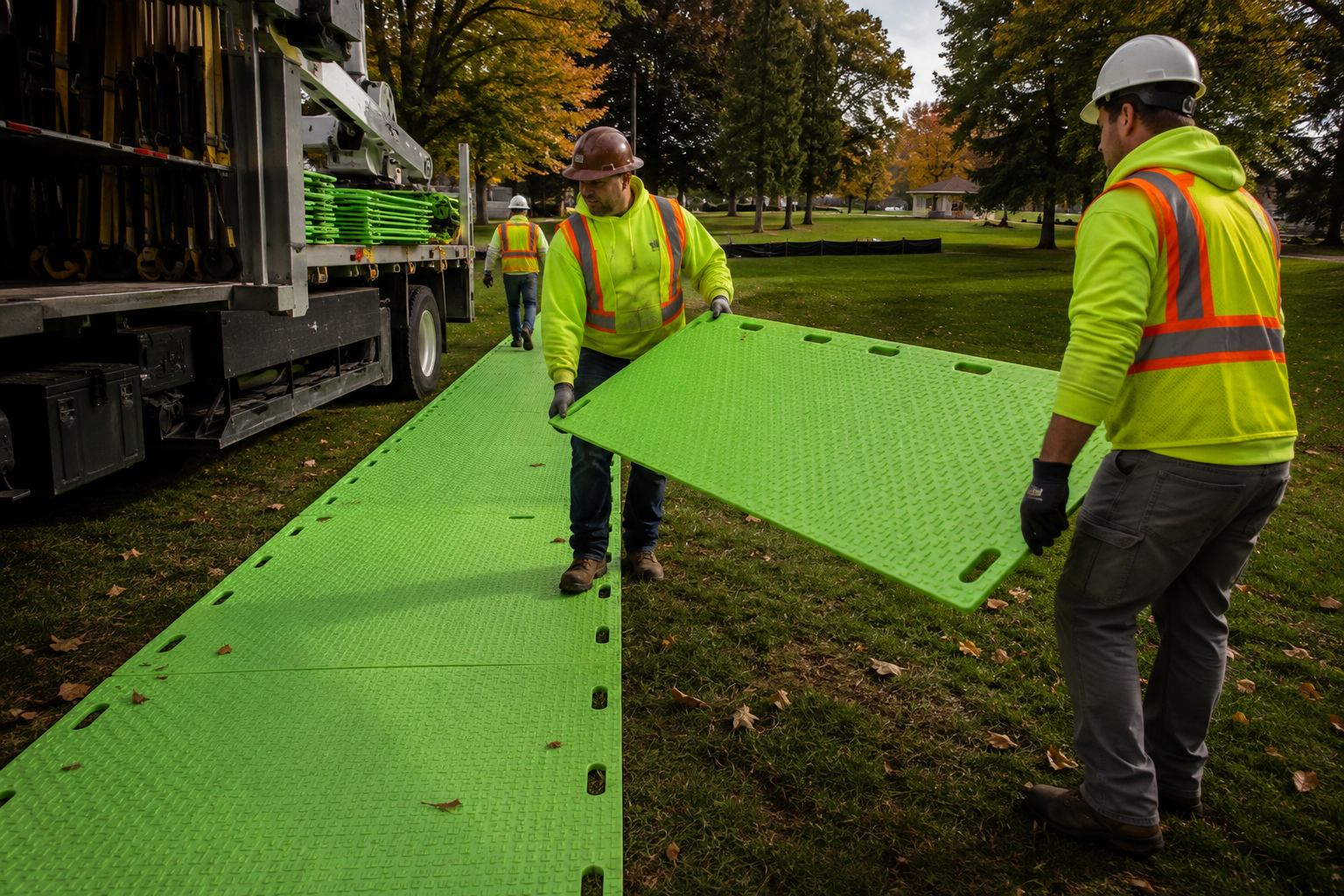
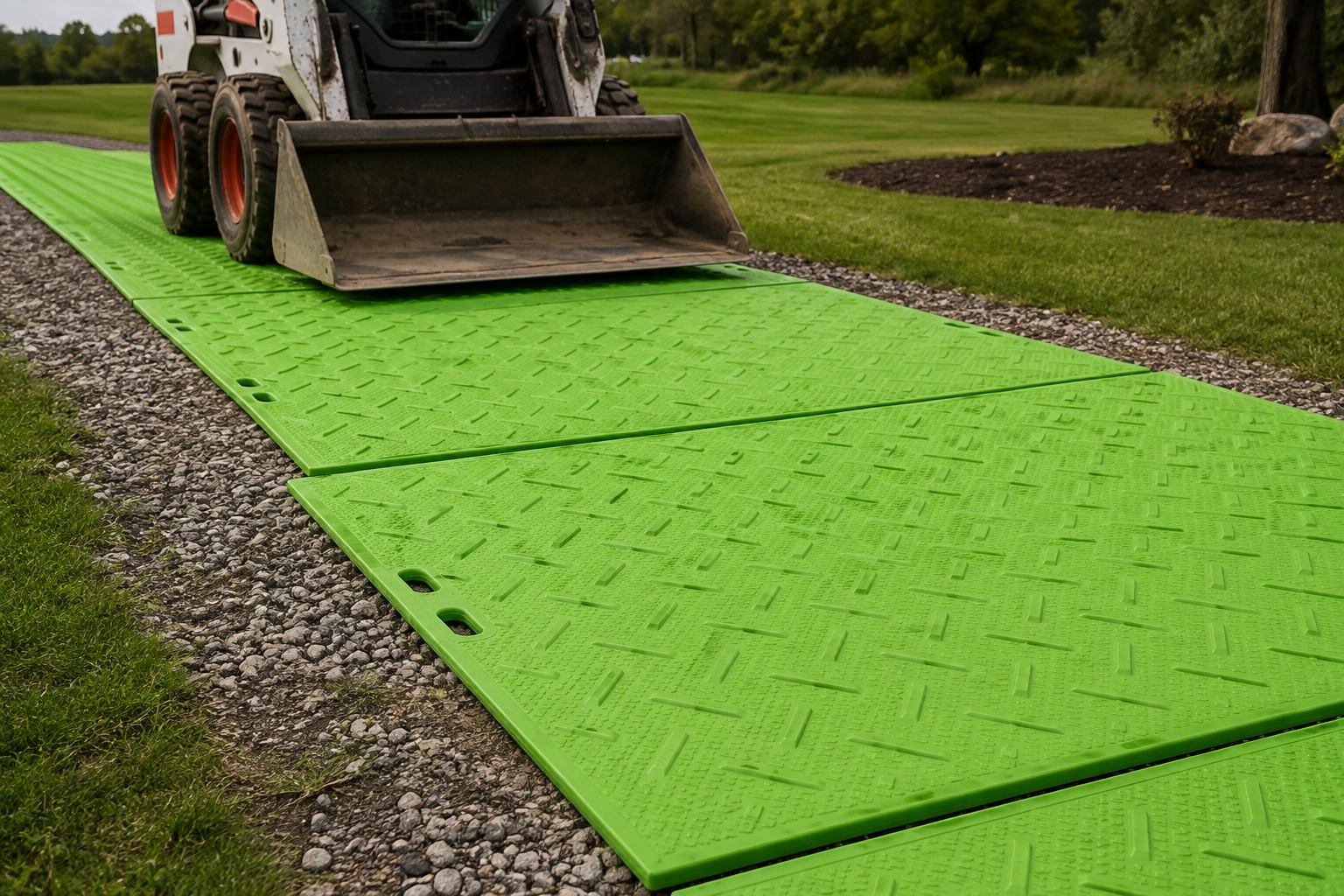
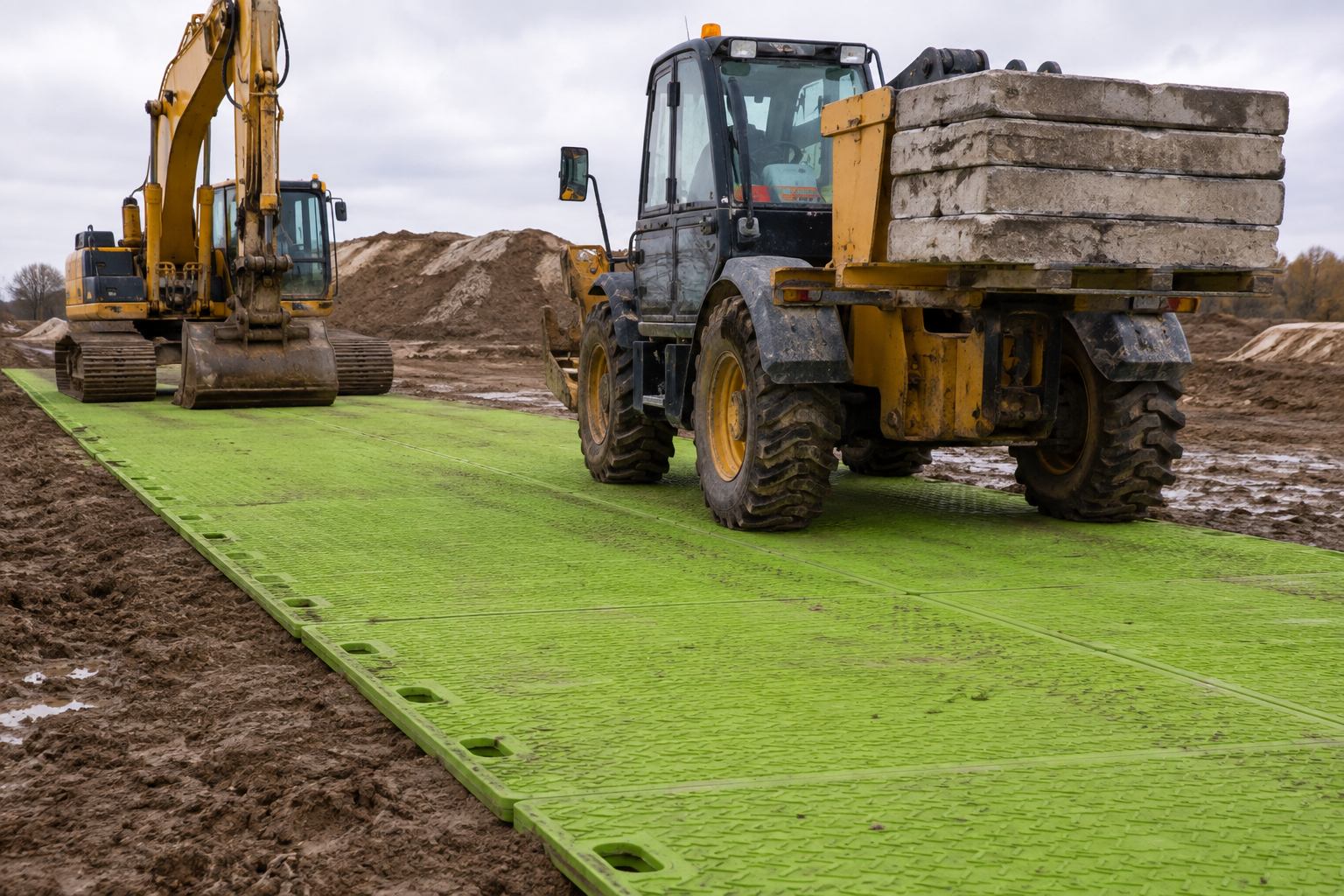
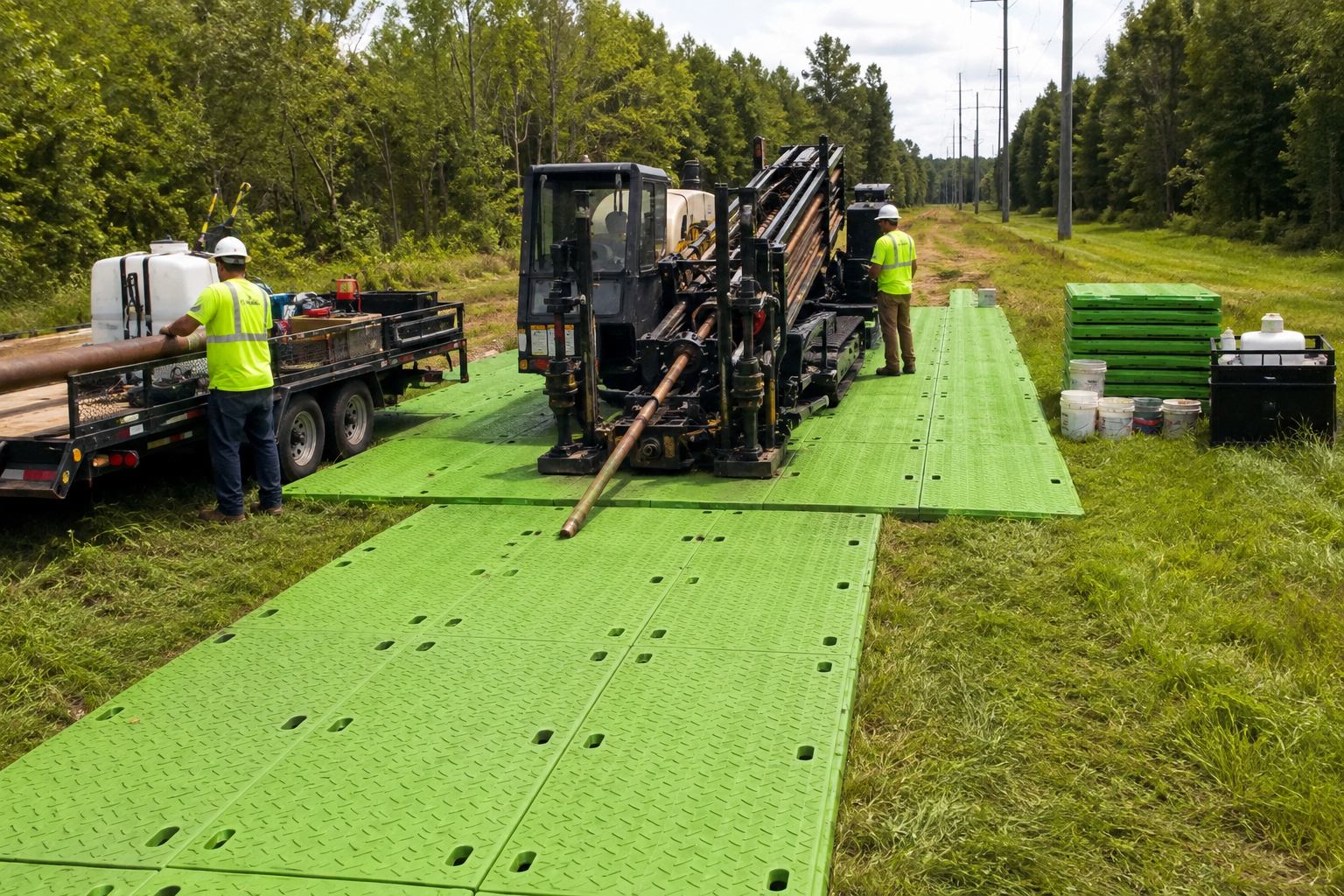
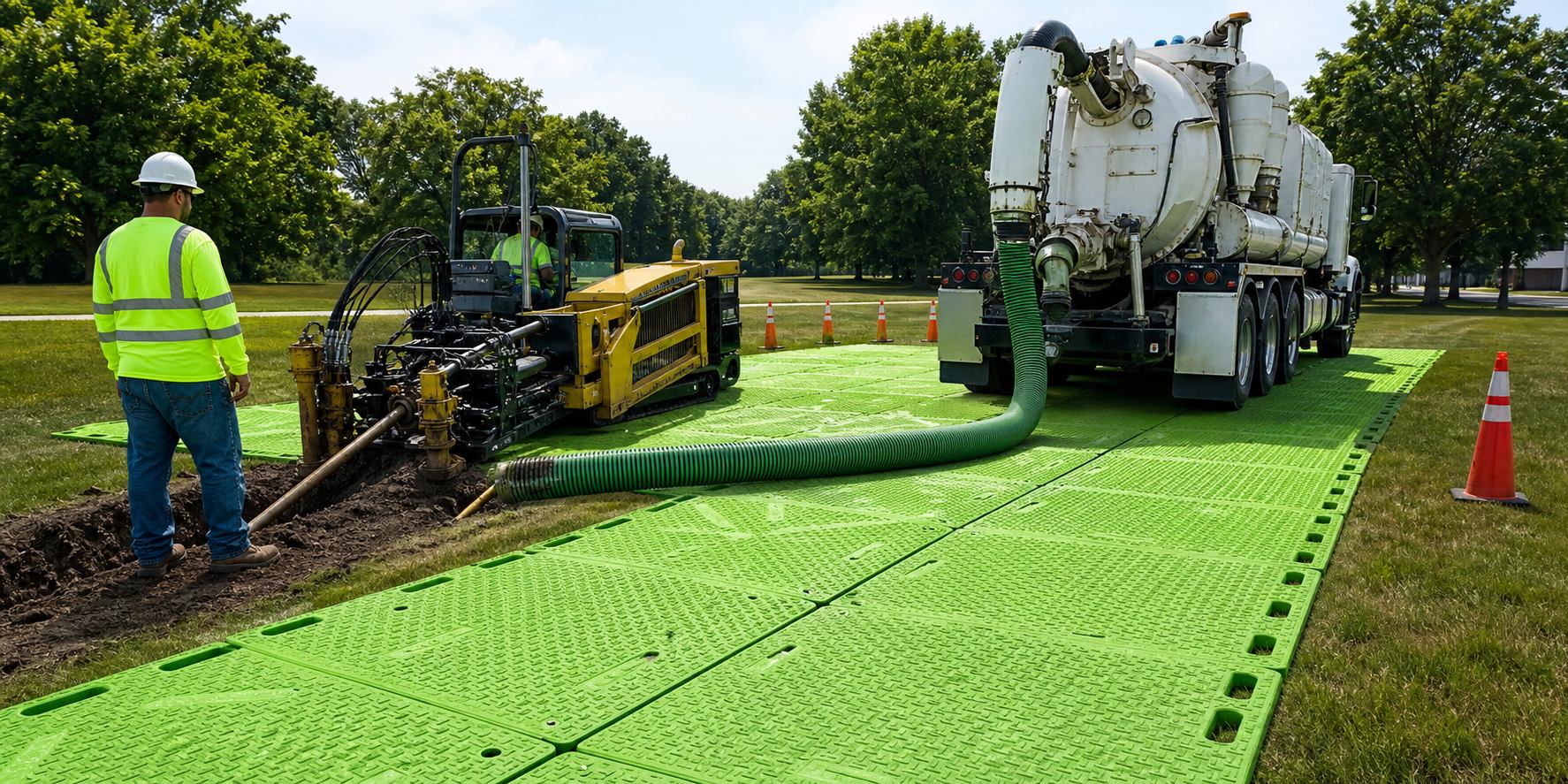
BAM! 4×8 HDPE panels placed on saturated ground create a bridging effect: the panel spans across the soft zone and transfers load to firmer ground at the panel edges, or simply distributes the load across 32 square feet of contact area rather than concentrating it under tire contact patches.
The machine rides on the rigid HDPE surface — which does not compress or deform. Traction is maintained because the mat surface provides grip that mud cannot. The ground below experiences reduced pressure. The machine continues moving instead of sinking.
Building a Mud Mat Access System That Holds Up
Assess before deploying — don’t wait for the machine to get stuck
The most expensive mud mat mistake is deploying after a machine has already gotten stuck. At that point, you need the mats and you need recovery equipment. Deploy mats before equipment moves, based on a pre-job soil assessment:
- Press a heel firmly into the ground. If you sink more than 1 inch, equipment will struggle without mat coverage.
- Check recent weather. Any significant rain in the past 48 hours on clay-heavy soil is a mud mat indicator regardless of current surface appearance.
- Look for standing water near the access route. It indicates subsurface saturation even if the surface looks dry.
Deploy from firm ground inward
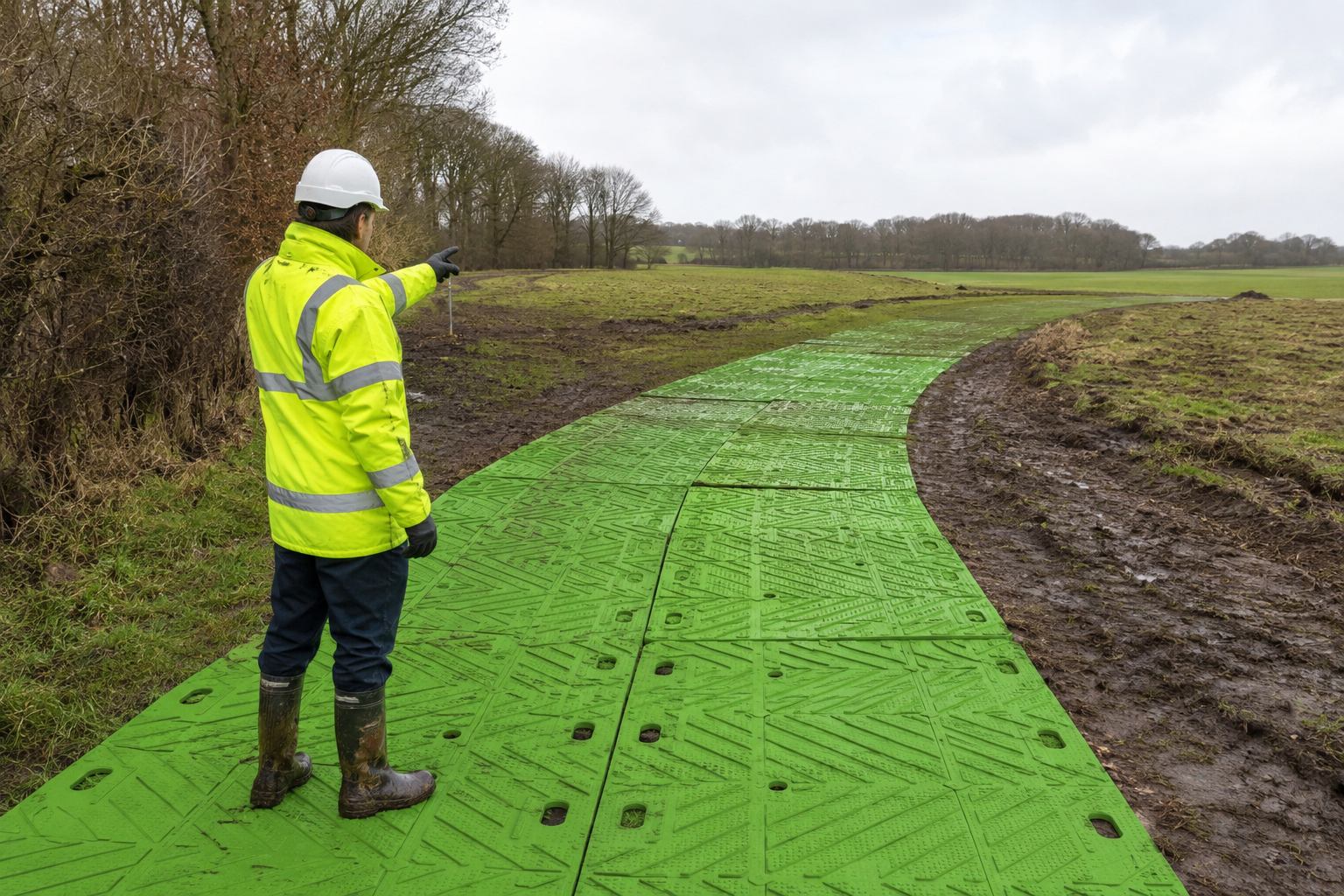
Start mat deployment from the firmest available surface — the street apron, a gravel drive, an existing concrete pad — and work toward the soft zone. This gives the crew a stable starting platform and prevents the deployment itself from becoming a mud problem.
Double coverage in the worst sections
The softest sections of an access route are where mat failure creates the most serious operational problems. Use double-column or wider coverage in areas where ground conditions are worst. The extra panel investment at problem sections is trivial compared to the cost of recovery.
Extended coverage at turning zones
Machines in mud conditions that need to turn are at highest risk of losing traction and digging in. Extended turning zone coverage — 4 to 6 extra panels beyond the standard path width — gives the operator room to complete turns without driving into unprotected ground.
Add panels as conditions change
Ground conditions during a job are not static. Rain during the workday, afternoon temperature changes, and repeated equipment passes all affect soil bearing capacity. Keep extra panels available on site for rapid deployment when conditions deteriorate beyond the initial setup.
BAM! Mat Features That Matter Most for Mud Applications
HDPE’s zero moisture absorption: panels deployed in mud and standing water perform identically to dry panels — no swelling, no structural degradation, no performance change from extended wet deployment
80-ton rating with real margin: equipment struggling in soft ground sometimes makes sudden movements — spinning tires, abrupt stops — that create dynamic loads above static weight. The margin in BAM!’s 80-ton rating handles these events
Dual-sided tread in wet conditions: both the equipment side (machine traction) and pedestrian side (crew footing) maintain their function when wet — critical when mud is involved on all surfaces around the access route
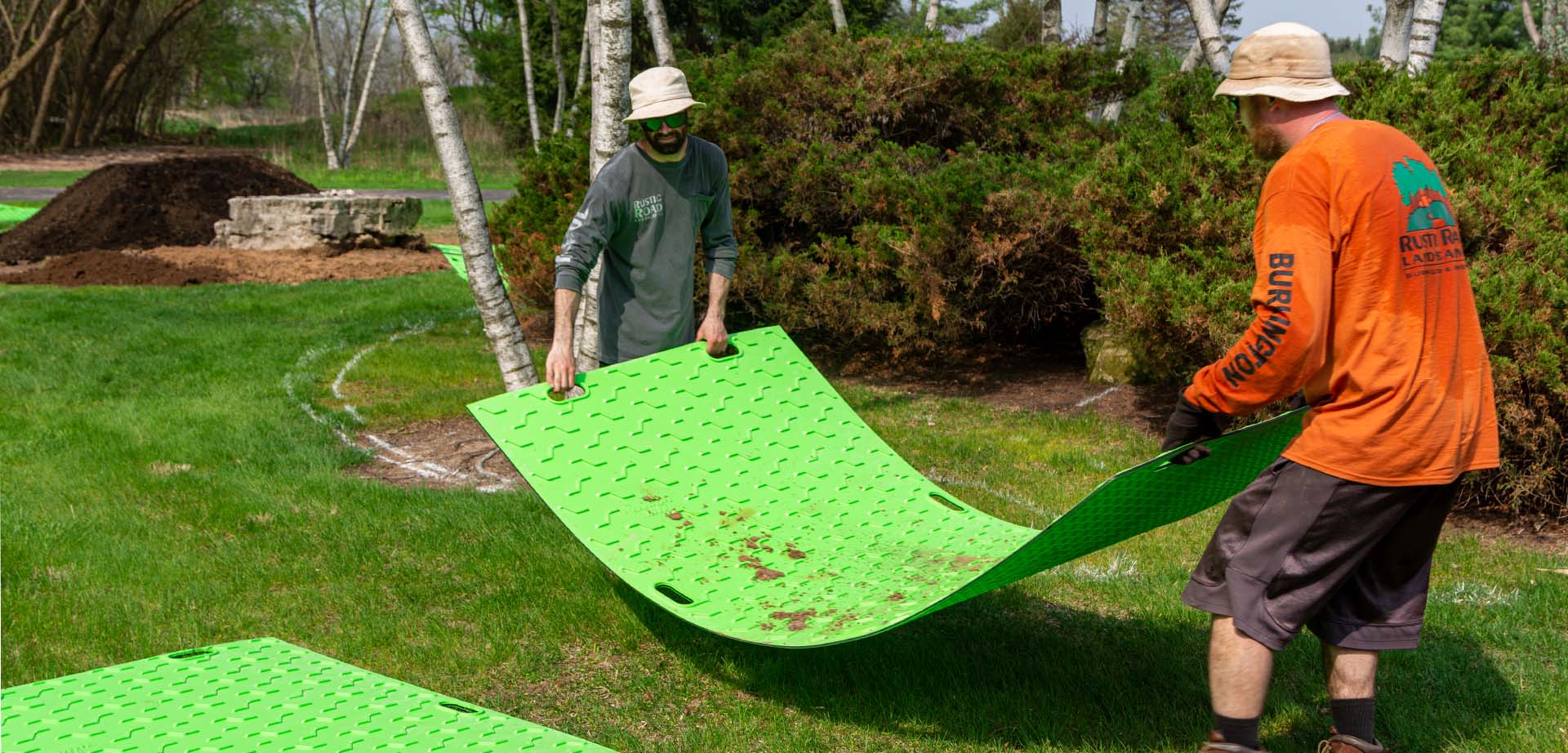
56-pound panels with 8 hand holds: mud deployments require rapid panel placement and repositioning; heavier panels slow this process when speed matters most
HDPE cleans completely: mud releases from HDPE with a pressure wash — no bonding, no staining, no residue — so panels from a muddy deployment are clean and ready for the next job
What Happens When Mud Mat Deployment Fails
The contractor who skipped mud mats on a site that looked ‘probably okay’ has experienced this sequence: first the machine slows down, then the tires start spinning, then forward progress stops entirely. Now the machine is stuck in a client’s backyard.
Recovery options are all expensive. Pulling with another machine requires having another machine available — and risks getting the recovery machine stuck too. Waiting for the ground to dry can mean days of lost productivity. Calling a recovery service adds cost and delay.
The cost of the mud mats that would have prevented this is, in almost every case, less than the cost of a single recovery event.
Frequently Asked Questions
Q: Can mud mats completely replace gravel access roads for heavy equipment in wet conditions?
A: For most residential and light commercial applications, yes. HDPE panels create a load-bearing surface that handles equipment in conditions where gravel would also need to be installed. For very heavy, sustained traffic over weeks, gravel underlayment can improve the system — but for typical project durations, mats alone are sufficient.
Q: How do I retrieve mud mats after a wet deployment?
A: HDPE does not bond to mud — panels lift cleanly from the surface. Crew members use the 8 hand holds to retrieve panels one at a time. For very deep mud, the leading edge of adjacent panels can be used as a pry point to break suction. Pressure wash before stacking for transport.
Q: Do mud mats work in standing water?
A: Yes. BAM! HDPE panels are inert in water and maintain their structural performance submerged or in standing water. For deployments in actual water — drainage corridors, stream crossings — contact BAM! at 888-870-8158 to discuss application-specific guidance and any applicable regulations.
Q: How many mud mats do I need for a spring excavation job on a residential lawn?
A: Spring conditions typically require 25 to 50 percent more coverage than the same job in dry summer conditions — because soft sections extend further and the stakes of inadequate coverage are higher. Plan for 20 to 28 panels for a residential excavation job in spring conditions. Call 888-870-8158 for site-specific sizing.
Stop Reacting to Mud. Start Planning for It.
The contractors who never get machines stuck are not the ones with better luck — they are the ones who treat mud mat deployment as a standard pre-job step rather than an emergency response. Plan for mud as a default. Deploy before conditions deteriorate. Keep panels on the truck.
Explore BAM! mud mats for heavy equipment at bamgroundpro.com/products. Find a distributor at bamgroundpro.com/where-to-purchase. Contact us at bamgroundpro.com/contact-us, call 888-870-8158, or email msheridan@alliedplastics.com. Work cleaner. Work safer. Pro’s choose BAM!