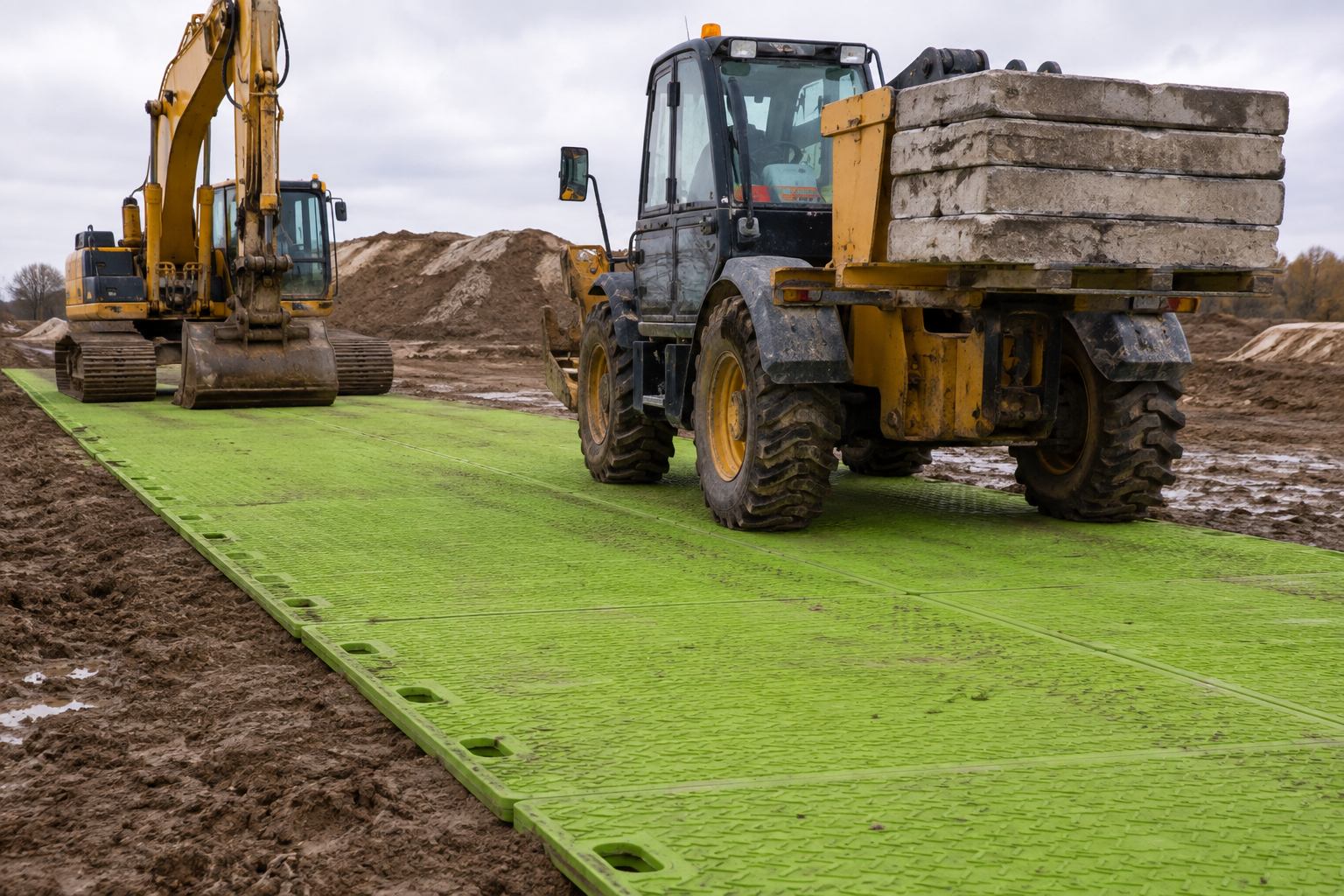
Most ground protection mats have one tread pattern. One side faces down on the ground. One side faces up for equipment. The panel does one job: let machines roll over it without the mat shifting.
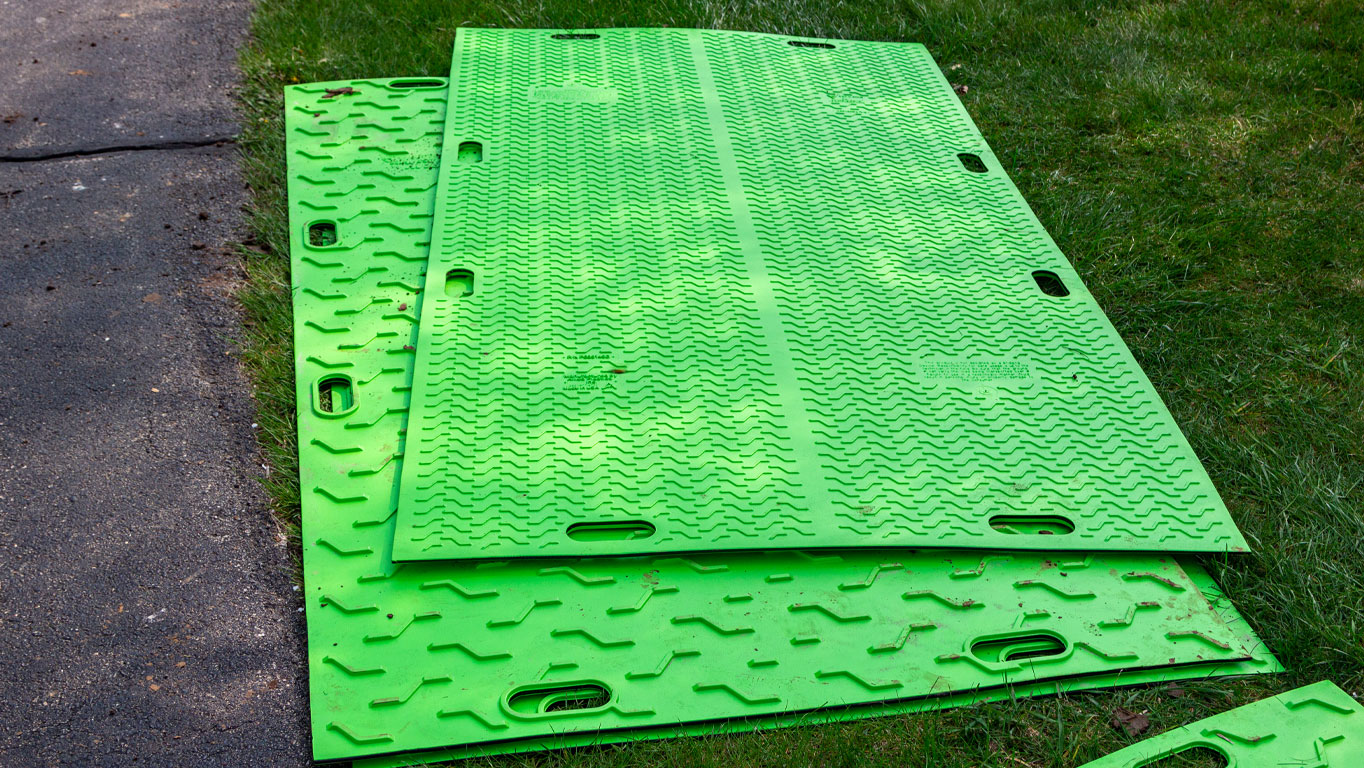
BAM! Bad Ass Mats are different. Every 4×8 BAM! panel has two distinct tread patterns — one engineered for equipment grip, one engineered for pedestrian traction. The panel serves two different users simultaneously, and both get a surface designed specifically for them.
This design exists because construction jobsites always have both machines and people on them. Optimizing for only one was the wrong answer.
The Problem With Single-Sided Mats on Active Jobsites
Here is the situation that reveals the limitation of single-sided mat design: equipment is traveling on the mat. The machine operator needs traction. A crew member needs to walk alongside to reposition the next panel, retrieve equipment, or perform work adjacent to the travel path.
On a single-sided mat optimized for equipment, the crew member is walking on a surface designed for tire contact — wider channels, aggressive tread geometry suited to machine weight distribution. That surface can be harder to navigate on foot, especially in wet conditions. Boot edges can catch on the tread pattern. The surface that grips a 10,000-pound machine is not the same surface that provides confident footing for a person carrying a 50-pound panel in the rain.
The double-sided design eliminates this compromise by addressing both user types on the same panel.
The Equipment Side: Engineered for Machine Traction
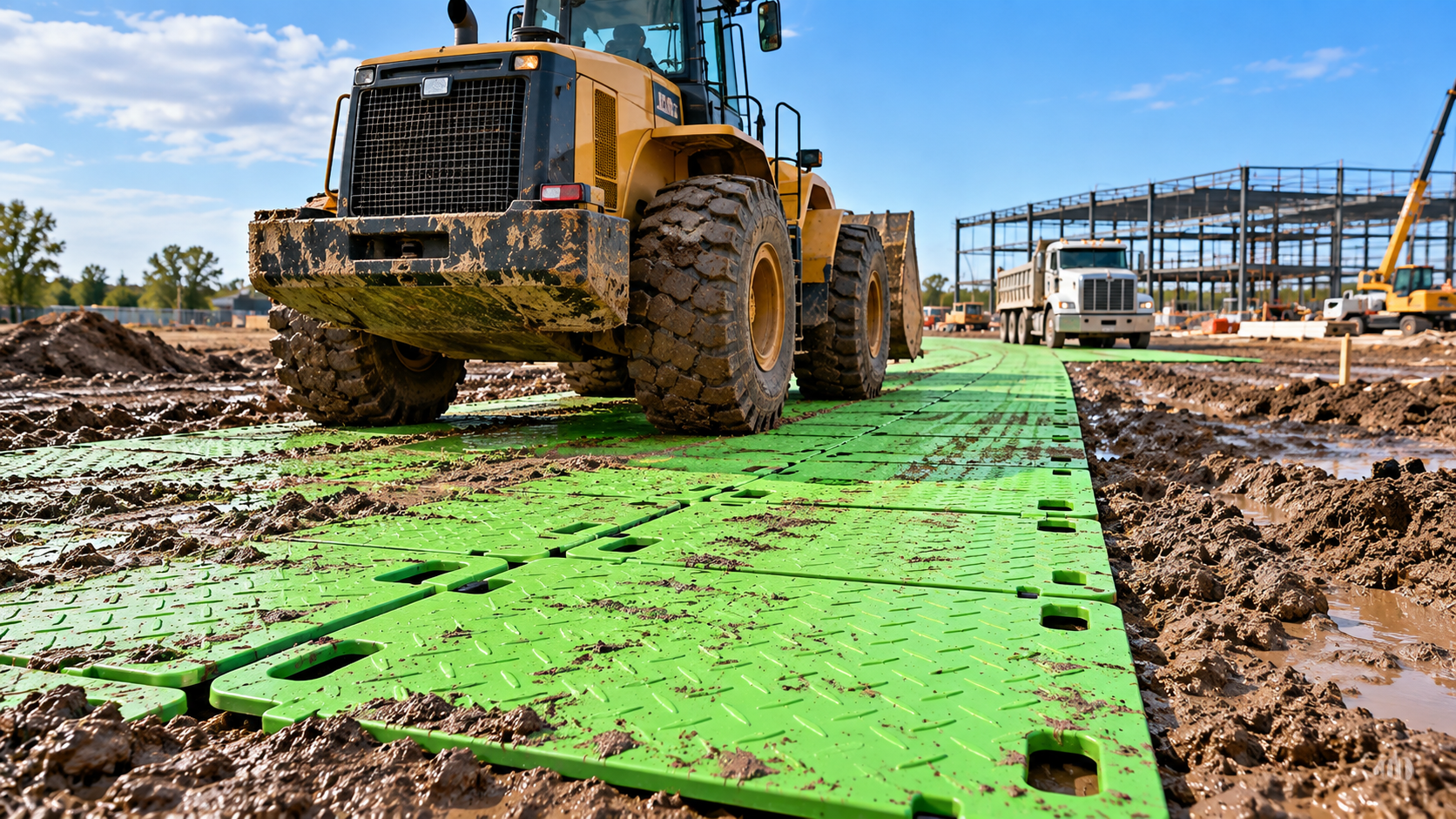
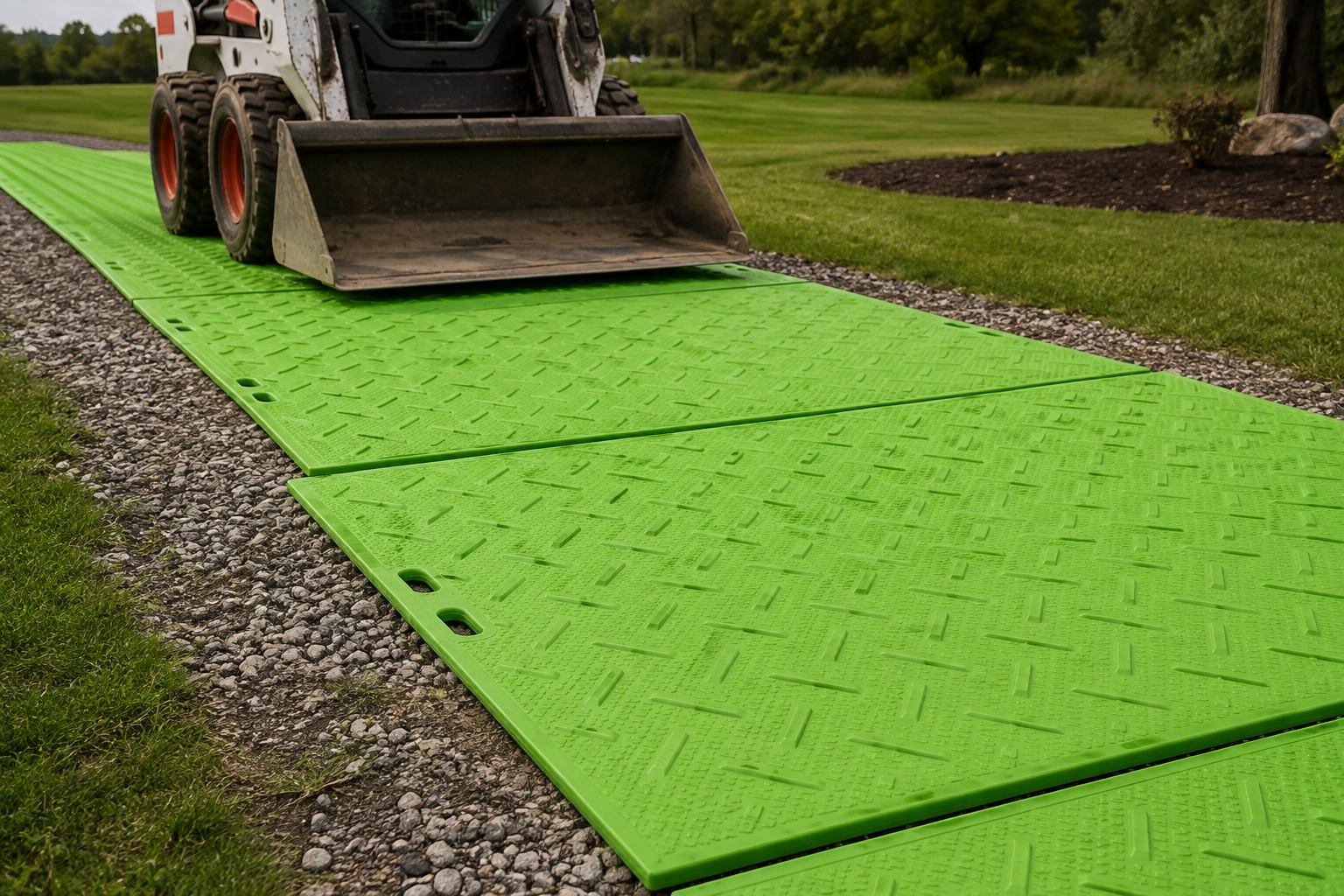
The equipment-facing tread pattern on BAM! 4×8 mats is designed around the mechanics of how machines make contact with a mat surface:
- Distributed grip across the full tire contact patch — preventing any localized slip that creates jerky, unpredictable machine movement
- Channel geometry that evacuates mud and debris from under tires, maintaining traction even when the mat surface is contaminated
- Consistent surface contact that allows equipment operators to work at normal speed without compensating for traction uncertainty
- Grip that functions equally in wet and dry conditions — because equipment jobs do not stop when it rains
The result is a mat that operators trust. Equipment moves across BAM! panels at working speed without traction hesitation — which means faster job completion and less equipment wear from fighting inconsistent traction.
The Pedestrian Side: Engineered for Crew Safety
The pedestrian-facing tread pattern uses different geometry to serve the different mechanics of boot contact:
- Finer, more uniform tread that provides consistent contact with boot soles across the full step — not just at the leading and trailing tread edges
- Surface texture that grips boot rubber without catching boot edges, allowing normal walking motion without the ankle twist risk that aggressive equipment tread can create
- Slip resistance maintained in wet, muddy, and contaminated conditions — when field conditions are worst and crew safety risk is highest
- Stable surface for loaded carries — crew members carrying panels, materials, or tools need confident footing, and the pedestrian tread delivers it
Construction sites are routinely ranked among the highest-risk environments for slip-and-fall incidents. A crew working around heavy equipment in wet field conditions faces real injury risk from inadequate footing surfaces. The pedestrian tread on BAM! mats directly reduces this risk.
The Interlocking Stack Feature: The Third Function of the Dual Tread
The two tread patterns do something besides serve equipment and crew during deployment — they interlock when panels are stacked.
When BAM! panels are stacked face-to-face for transport and storage, the equipment tread pattern on one panel meshes with the pedestrian tread pattern on the next. The panels seat into each other and do not shift during transport — even on rough roads and across long distances.
This is not accidental. The tread geometry was designed with this stacking behavior as a specific goal. The practical result is that panels arrive at the job organized and stable — not jumbled from transit — and are ready to deploy immediately without sorting or straightening.
How to Deploy Double-Sided 4×8 Mats Effectively
Choosing which side faces up
In most deployments, the equipment side faces up on active equipment travel paths and the pedestrian side faces up in zones where crew is the primary user. In mixed zones where both machines and crew are active, the equipment side is generally preferred because machine traction failure creates greater safety risk than pedestrian slip — but both sides provide adequate safety for normal use.
Consistent orientation across a path
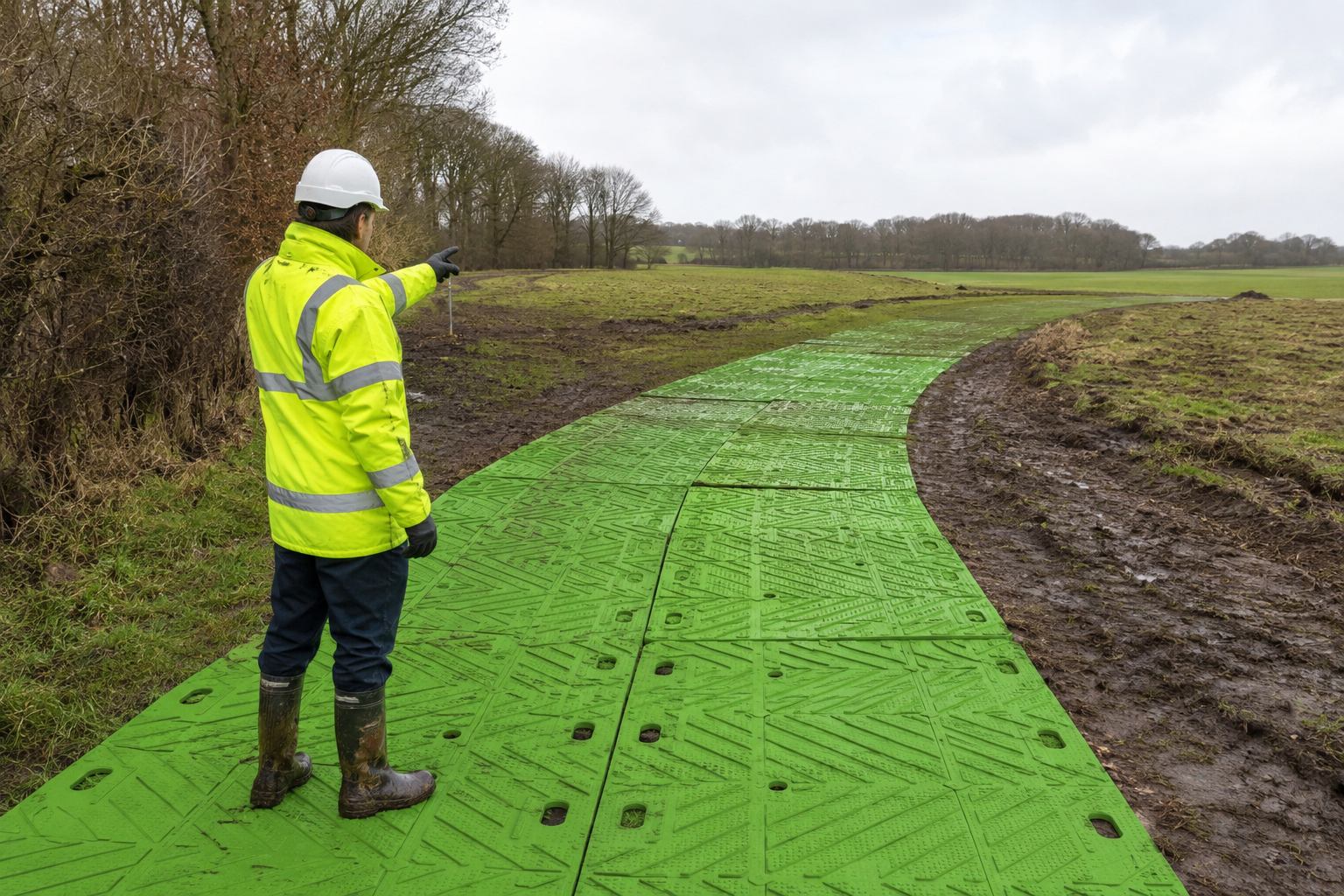
Within a continuous travel path, deploy all panels with the same side up. Mixing orientations creates subtle surface transitions that equipment operators and crew members can sense — consistent orientation provides a uniform, predictable surface across the full route.
Turning zones and high-crew-activity areas
Turning zones where equipment pivots frequently are where equipment traction is most critical — deploy equipment side up. Material staging areas and crew working zones where machines are stationary and crew is most active — consider pedestrian side up for crew safety.
The 4×8 Format: Why It Is the Standard
The 4×8 foot format (32 square feet per panel) has become the standard for ground protection mats because it balances coverage area with handleability. A smaller panel requires more panels and more panel-to-panel transitions. A larger panel would exceed single-person handling capacity.
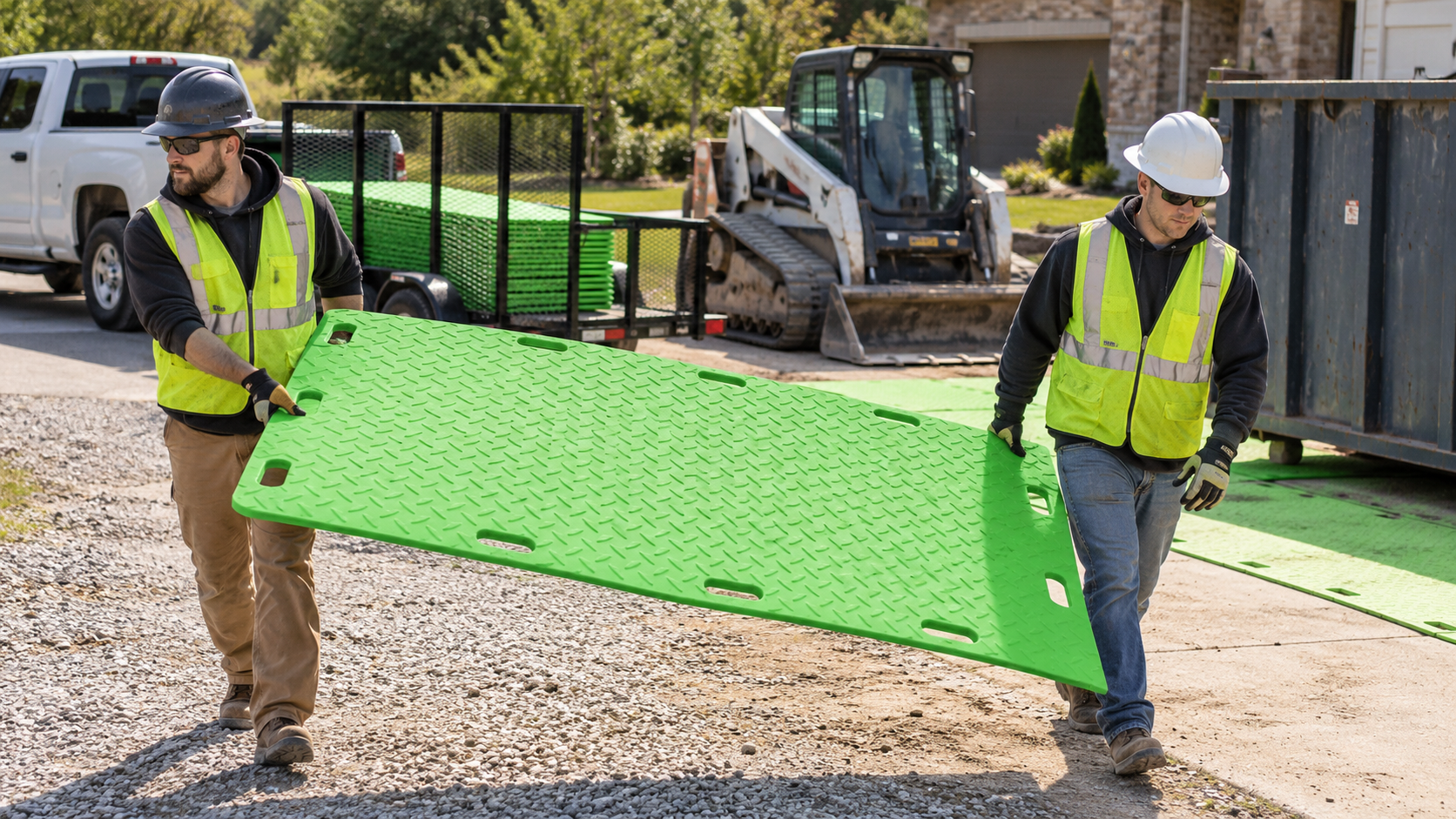
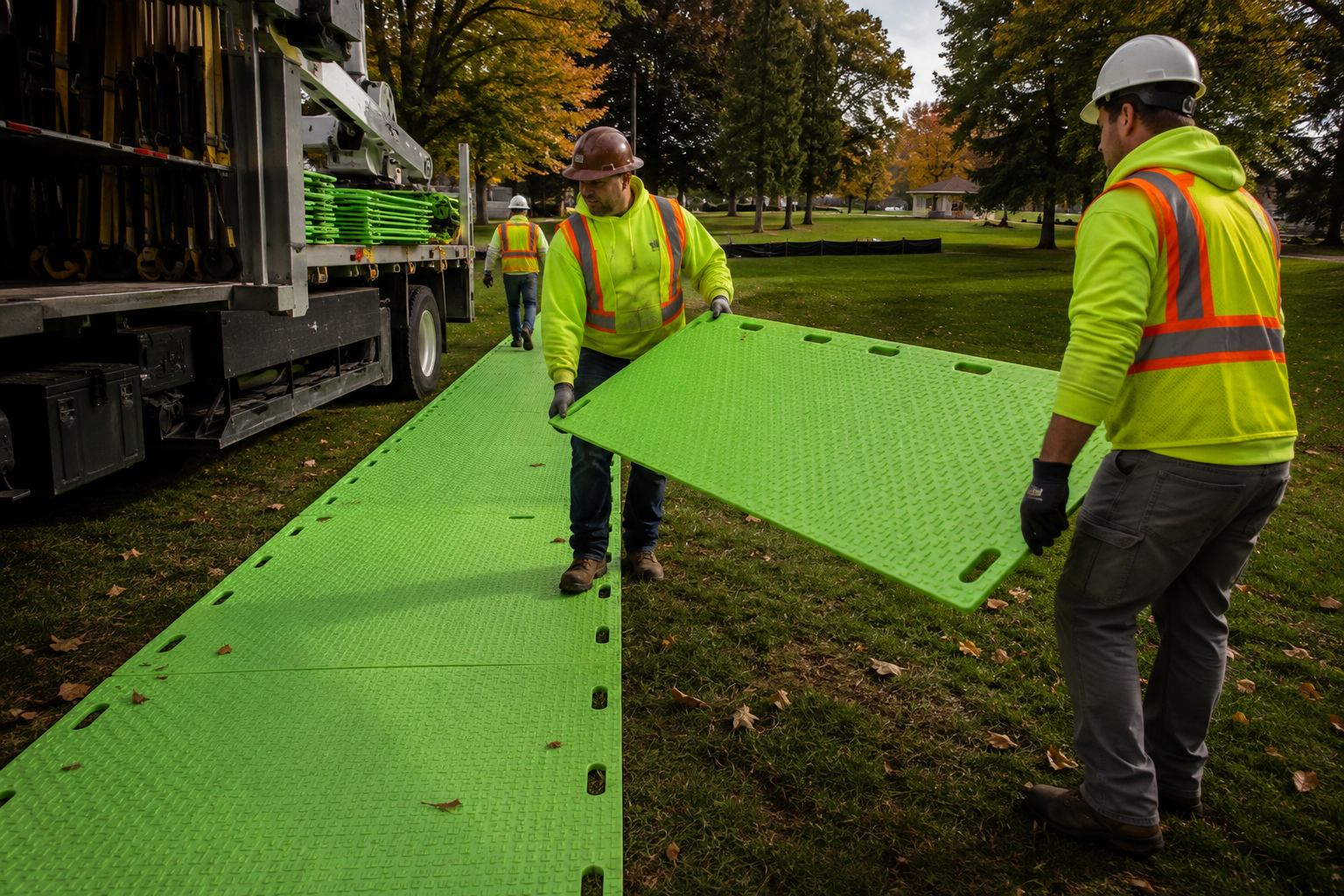
At 56 pounds per 4×8 BAM! panel — with 8 large hand holds designed for gloved hands — this size can be deployed by a single crew member at full working pace. The double-sided design adds no weight to this baseline; the surface geometry does not add material, it reshapes what is already there.
Frequently Asked Questions
Q: How do I tell the equipment side from the pedestrian side on a BAM! mat?
A: The two tread patterns have distinct geometries that are visually different. Visit bamgroundpro.com/products for clear photographs of both tread faces. For field reference, the equipment side typically has wider, more aggressive channels; the pedestrian side has finer, more uniform tread.
Q: Does the double-sided design affect the load rating of the mat?
A: No. The 80-ton load rating applies identically regardless of which side faces up. The tread design is a surface feature — the structural performance of the panel is determined by the full HDPE cross-section, not the surface geometry.
Q: Are BAM!’s 2×8 panels also double-sided?
A: Yes. The BAM! 2×8 panels share the same dual-sided tread design as the 4×8 panels, with 4 hand holds (vs. 8 on the 4×8). The 2×8 is designed for tight access passages, gate crossings, and narrow coverage zones where the full 4-foot width is not practical.
Q: Does any other ground protection mat brand offer a dual-sided tread design?
A: BAM!’s dual-sided tread is an exclusive design. Most competing products offer a single tread pattern on one face. The dual-sided design is a specific engineering decision by Allied Plastics to address both equipment and pedestrian use on the same panel.
Q: Can the double-sided design be requested in custom tread configurations?
A: Contact BAM! at 888-870-8158 or msheridan@alliedplastics.com to discuss custom configurations and high-volume orders. Allied Plastics manufactures the product and can discuss specific requirements directly.
Two Users. One Panel. Zero Compromise.
The double-sided 4×8 ground protection mat design is not a marketing detail — it is an engineering answer to a real jobsite problem. Machines need traction. Crew needs footing. The site has both. The mat should serve both. BAM! does.
See both tread faces at bamgroundpro.com/products. Find a distributor at bamgroundpro.com/where-to-purchase. Contact us at bamgroundpro.com/contact-us, call 888-870-8158, or email msheridan@alliedplastics.com. Pro’s choose BAM!