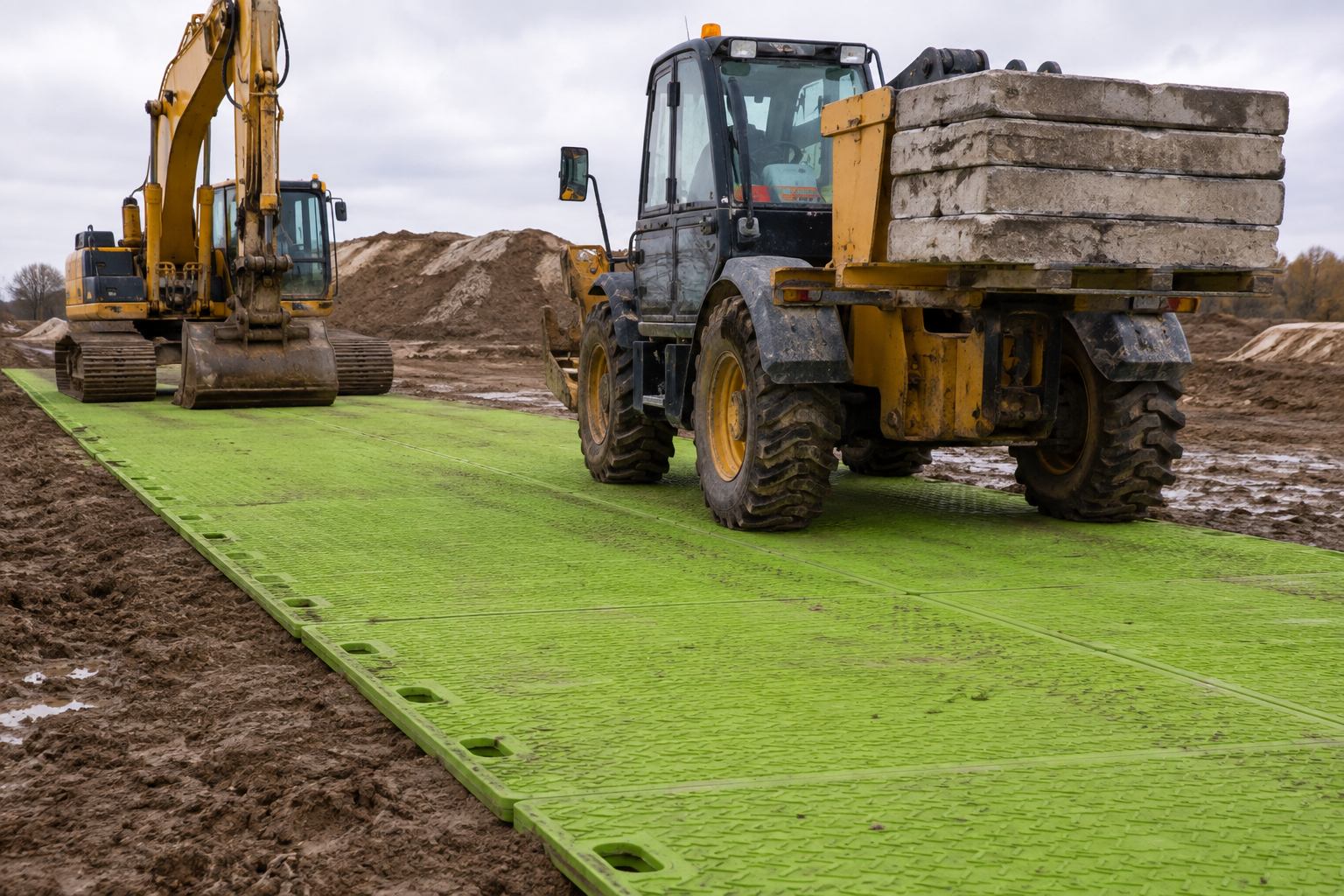
There is a specific type of ground damage that standard access route protection does not address: the damage that happens when heavy equipment deploys stabilizers, outrigger legs, or support pads and concentrates its full load through a small number of contact points.
A boom lift. A mobile crane. A large telehandler. A concrete pump truck. All of these machines extend legs or outriggers during operation — and when they do, they transfer massive loads through those legs into the ground below. Without the right ground pads under each contact point, the damage is significant and immediate.
The Point Load Problem Under Stabilizers and Outriggers
When a boom lift deploys its four outrigger legs and lifts all four wheels off the ground, the machine’s full weight — plus the dynamic load from boom movement and load handling — concentrates through four pads. A 30,000-pound boom lift on four outriggers applies 7,500 pounds per leg at minimum. During loaded lifts, dynamic forces can push individual outrigger loads significantly higher.
An outrigger pad might be 12 to 18 inches square — perhaps 200 square inches. Divide 7,500 pounds by 200 square inches: 37.5 pounds per square inch. On concrete, this can cause cracking or spalling. On asphalt, deformation. On turf, immediate and deep penetration. On soft soil, dangerous instability.
Ground pads solve this by extending the load across a much larger surface area before it reaches the ground.
Types of Equipment That Require Ground Pads
Boom lifts and aerial work platforms
Boom lifts — telescoping and articulating — deploy outrigger legs during operation. The larger the boom and the heavier the rated load, the higher the outrigger loads during use. Ground pads under each outrigger leg are required for any boom lift operation on soft, unstable, or paved surfaces.
Mobile cranes
Mobile cranes apply some of the highest point loads encountered in construction. Outrigger systems extend the crane’s effective footprint, but the loads concentrated at each outrigger pad position can reach tens of thousands of pounds per leg for larger cranes. BAM!’s 80-ton rating covers a significant range of mobile crane applications; for larger cranes, consult with a geotechnical engineer for site-specific bearing capacity assessment.
Telehandlers and forklifts
Telehandlers with extended booms and loaded forks shift the machine’s center of gravity forward, increasing the load on the front axle significantly. In this configuration, the front tire contact zones become pseudo-outrigger positions. Ground pads under front wheel contact areas protect surfaces during loaded telehandler operations.
Concrete pump trucks
Concrete pump trucks deploy outrigger stabilizers to counterbalance the boom during pumping operations. Outrigger loads during pumping can be substantial — the dynamic force from pumping pulsation adds to the static load at each leg. Ground pads are standard practice for concrete pump truck operations on residential driveways and commercial surfaces.
Scaffolding and shoring base plates
Heavy scaffolding systems and temporary shoring apply sustained loads through base plates to whatever surface they rest on. Ground pads under base plates on soft or paved surfaces distribute this load and prevent surface damage from sustained concentrated contact.
How to Size Ground Pads for Heavy Equipment
The coverage area calculation
The goal of a ground pad is to extend the load across a large enough area that the pressure per square foot is within the ground’s capacity to resist. Calculation approach:
- Determine the load per outrigger or leg (total equipment weight plus load divided by number of outrigger positions, with dynamic factor)
- Determine the ground’s bearing capacity (firm soil: 1,000 to 3,000 lbs/sq ft; soft/saturated soil: 200 to 500 lbs/sq ft)
- Calculate required area: load per leg / ground bearing capacity = required square footage per outrigger position
- Size your pad coverage to meet or exceed this required area
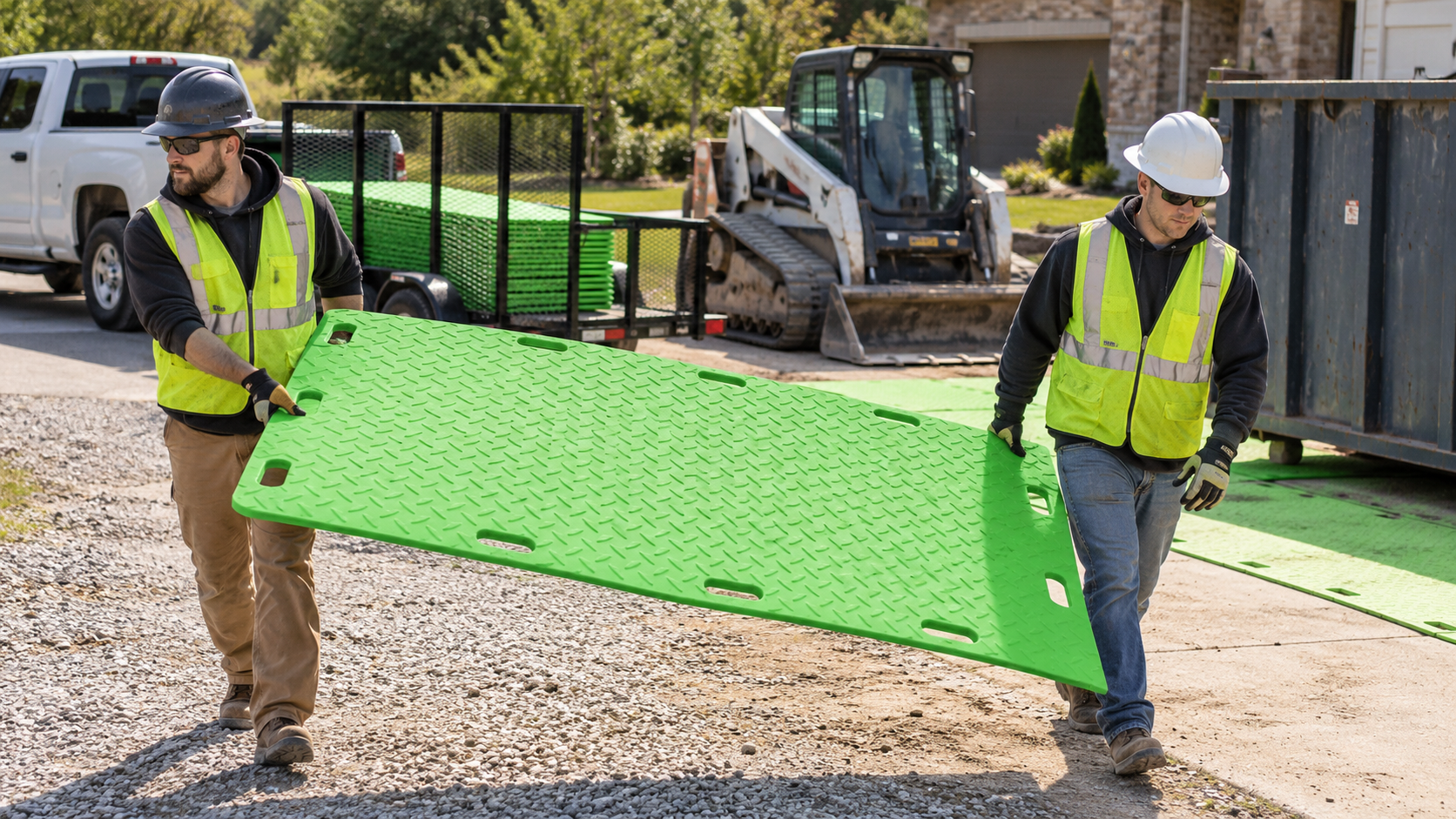
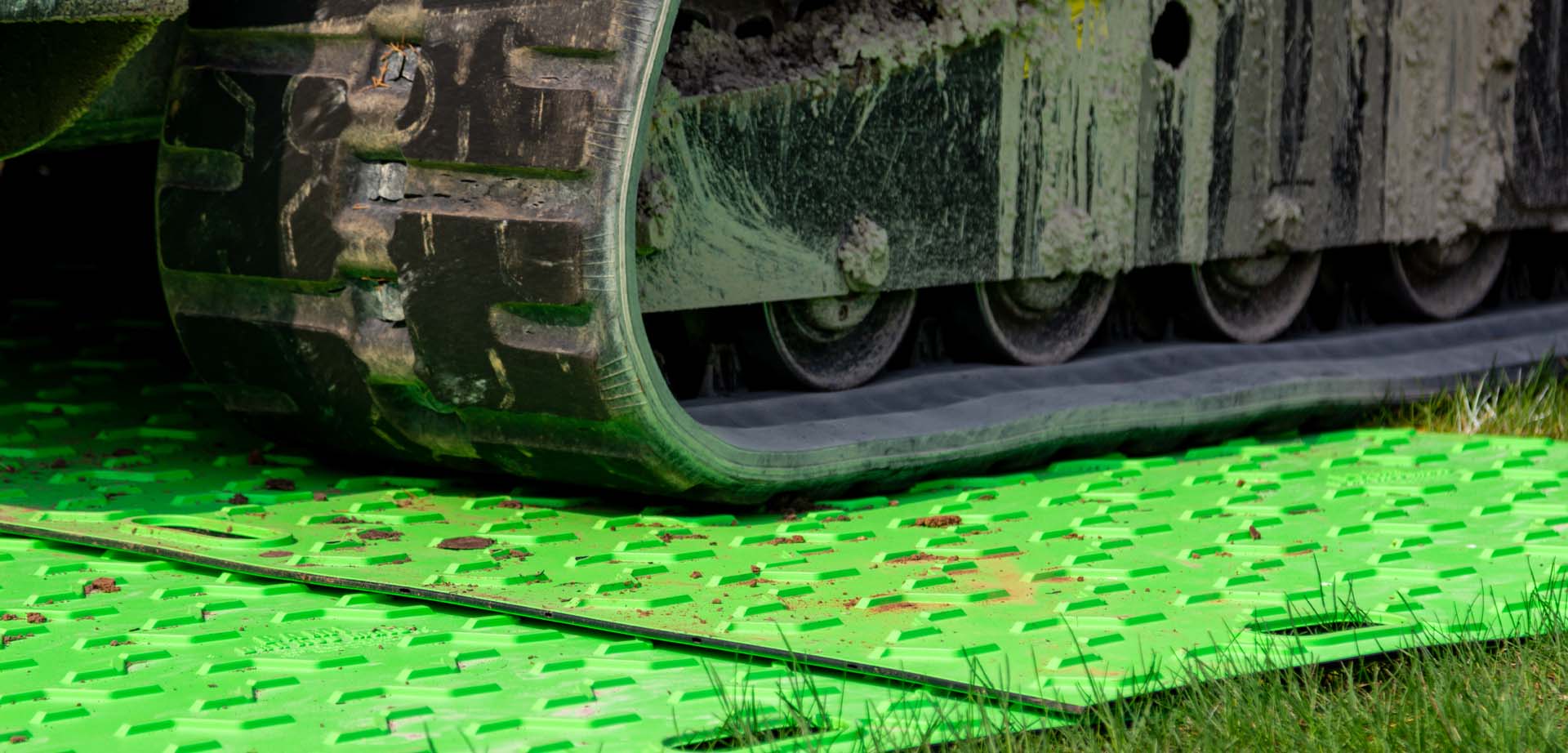
A single BAM! 4×8 panel provides 32 square feet of coverage per pad position. For higher outrigger loads or softer soil, two panels per position (64 sq ft) may be appropriate. Contact BAM! at 888-870-8158 to discuss sizing for specific equipment and soil conditions.
Outrigger pad placement vs. mat placement
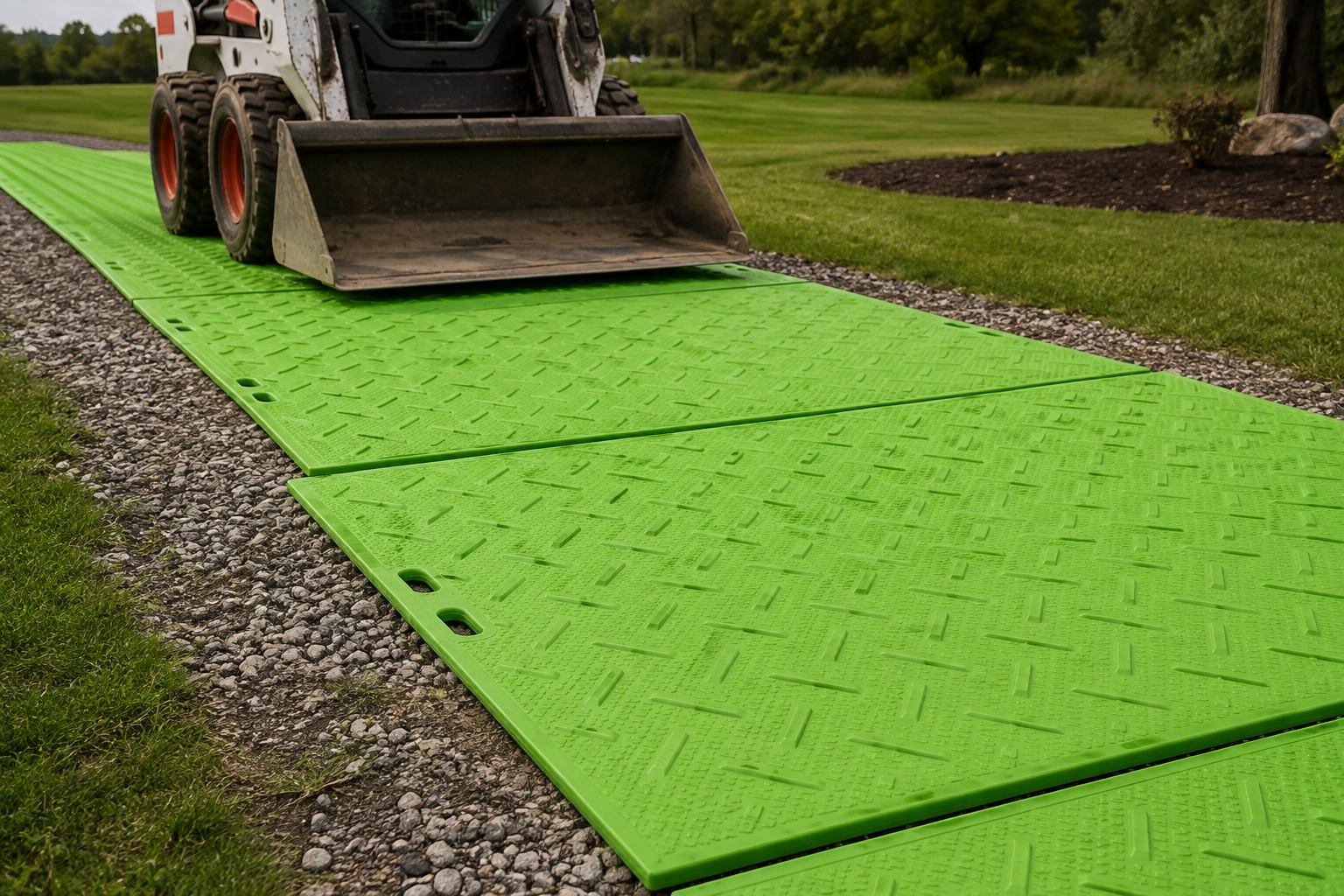
Ground pads under outrigger positions should be placed separately from the equipment travel path coverage — not as a continuation of the access route. The outrigger position typically extends beyond the machine’s travel footprint, requiring dedicated panels at each leg landing zone.
Ground pad placement sequence
- Place access route mats for equipment travel to the work position
- Position equipment at the work location before outriggers are deployed
- Place outrigger pad panels at each expected leg landing position
- Deploy outriggers onto the panels — never deploy outriggers and then try to place panels under them
Heavy Equipment Air Bridge Mats: A Related Application
Heavy equipment air bridge mats serve a different function from standard ground pads: they span across a void, gap, or transition zone to create a continuous load path where ground contact is unavailable or inadequate below the mat.
Air bridge applications include spanning across shallow drainage trenches, transitioning from paved surfaces to unpaved surfaces at abrupt grade changes, and bridging over soft or unstable sections where the ground has no bearing capacity even with load distribution.
For true air bridge applications — where the mat spans without full ground contact below — the structural requirements are higher than for standard ground pad use. Contact BAM! at 888-870-8158 to discuss bridging span length, load requirements, and whether additional engineering support is needed for your specific application.
Ground Pads on Common Surface Types
Concrete driveways and slabs
Outrigger loads on residential concrete can cause cracking, spalling, and damage at control joints. Ground pads distribute the load away from vulnerable joint zones and prevent the high-pressure point contact that cracks concrete slabs. This is the most common surface damage complaint from boom lift and concrete pump truck operations on residential jobs.
Asphalt parking lots and driveways
Asphalt is vulnerable to deformation under sustained point loads, especially in warm weather. Outrigger pads on asphalt without ground pad protection leave permanent leg impressions that are expensive to repair and create long-term drainage and structural problems in the asphalt surface.
Turf and landscaped areas
Outrigger loads on turf without ground pad protection create deep, clean holes at each leg position — the leg punches through the turf and into the soil. These holes require fill, compaction, and resodding to repair properly. Ground pads prevent penetration entirely.
Soft or saturated soil
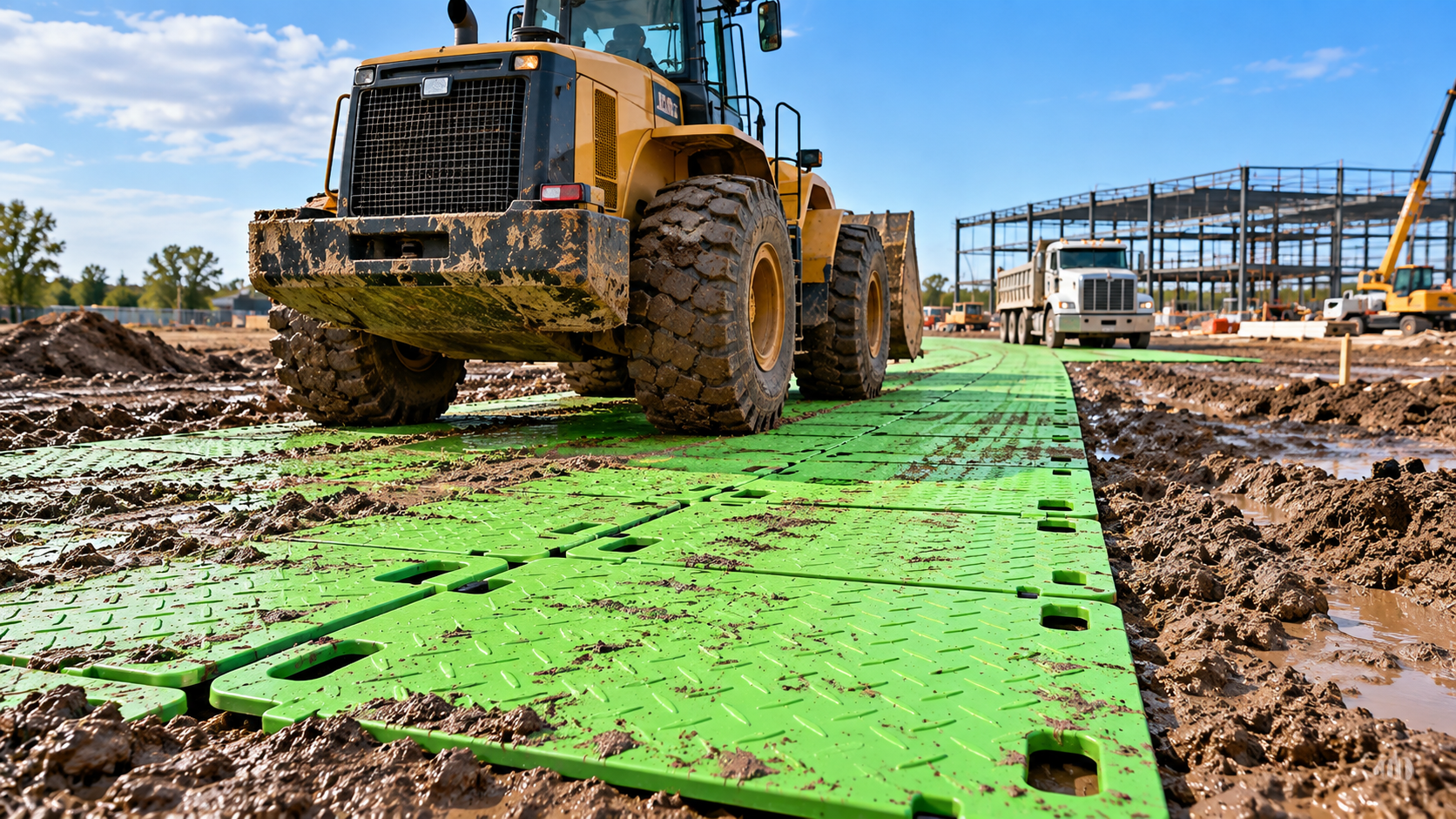
On soft or saturated ground, outrigger loads without adequate ground pad coverage can cause catastrophic stability failures — the leg sinks into the soft soil, the machine tilts, and the entire lift operation is compromised. Ground pad coverage on soft soil is not optional for outrigger-supported equipment — it is a fundamental safety requirement.
Frequently Asked Questions
Q: How many BAM! panels do I need for a standard boom lift outrigger setup?
A: A standard boom lift has 4 outrigger positions. Using 1 BAM! 4×8 panel per position requires 4 panels. For larger lifts on softer ground, 2 panels per position (8 panels total) provides additional load distribution. Access route coverage requires additional panels on top of outrigger coverage.
Q: Can I use BAM! mats as both ground pads and access route coverage?
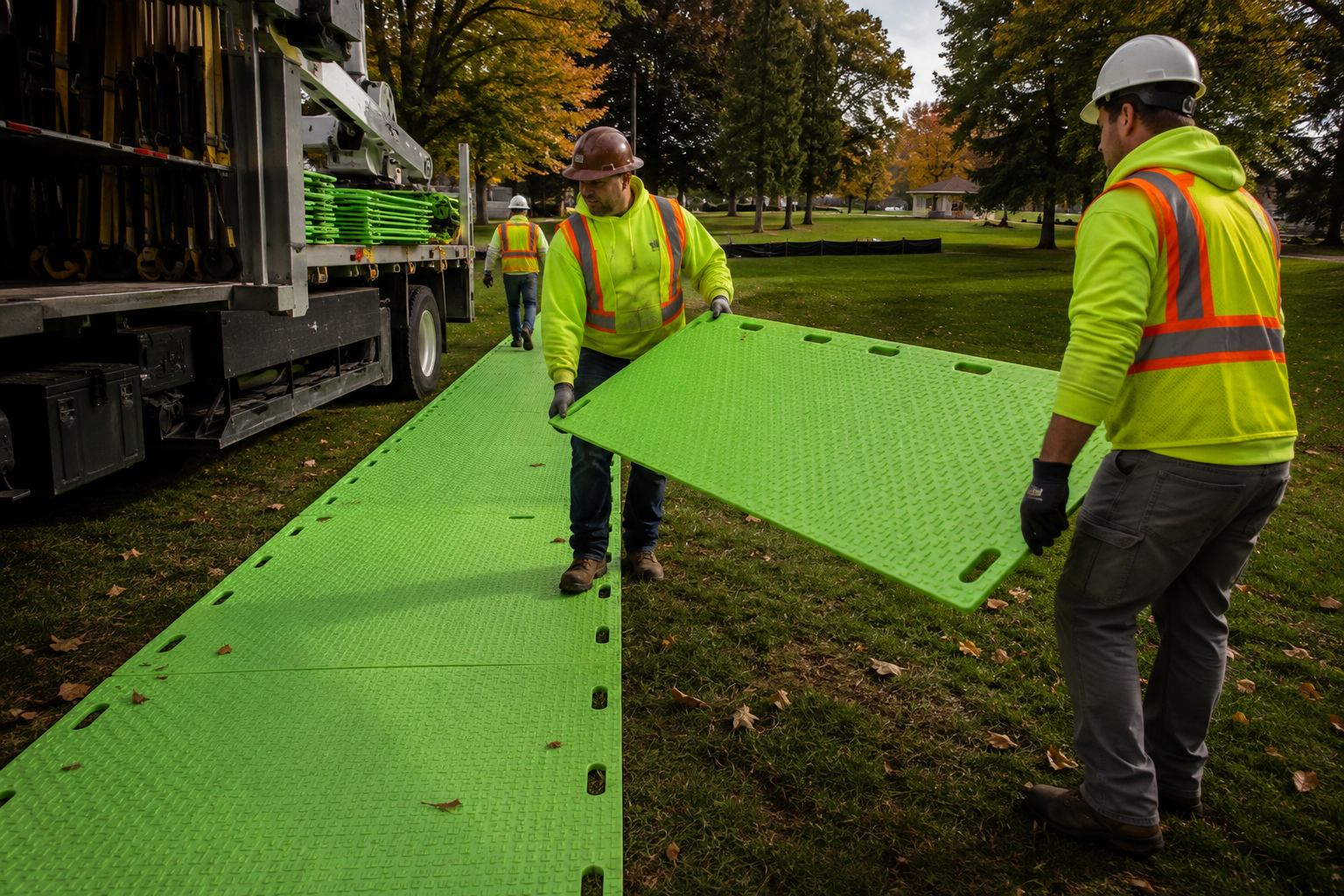
A: Yes. The same BAM! 4×8 panels serve both functions — access route coverage during equipment travel, then repositioned as ground pads at the outrigger positions once equipment is in place. This is a common workflow that maximizes the utility of each panel in the fleet.
Q: What is the difference between outrigger pads and ground protection mats?
A: Outrigger pads are specifically sized to match the outrigger foot dimensions and are placed at each individual leg position. Ground protection mats cover broader access routes. In practice, BAM! 4×8 HDPE panels are used for both functions — as route coverage during travel and as outrigger-position pads during operation.
Q: Does the 80-ton BAM! rating apply when the panel is used as an outrigger ground pad?
A: The 80-ton rating reflects distributed load across the panel surface. Outrigger loads are point loads concentrated in the outrigger foot area, which is typically smaller than the full panel. For high outrigger loads, using multiple panels per position increases the effective load distribution area. Contact BAM! at 888-870-8158 for specific outrigger load guidance.
Protect Every Contact Point. Not Just the Path.
The most serious jobsite damage from heavy equipment does not happen on the travel path — it happens at the outrigger positions where load concentrates to its maximum. Ground pads at every stabilizer and outrigger position are the specific protection that prevents the most expensive damage events on jobs involving lift equipment, cranes, and concrete pumps.
Plan your ground pad setup at bamgroundpro.com/products. Find a distributor at bamgroundpro.com/where-to-purchase. Contact us at bamgroundpro.com/contact-us, call 888-870-8158, or email msheridan@alliedplastics.com. Protect every contact point. Pro’s choose BAM!