Every equipment-intensive job has an access challenge. The work is in the backyard. The equipment is on the street. In between is a lawn, a driveway, a landscaped easement, or a soft drainage corridor that cannot handle equipment weight without protection.
Temporary access road construction with HDPE ground protection mats solves this challenge in minutes—without gravel, without excavation, and without permanently altering what is underneath.
What Temporary Access Road Construction Actually Means
‘Temporary access road construction’ does not mean building a road. It means creating a load-bearing surface that allows equipment to travel from its staging point to the work zone without damaging the ground in between.
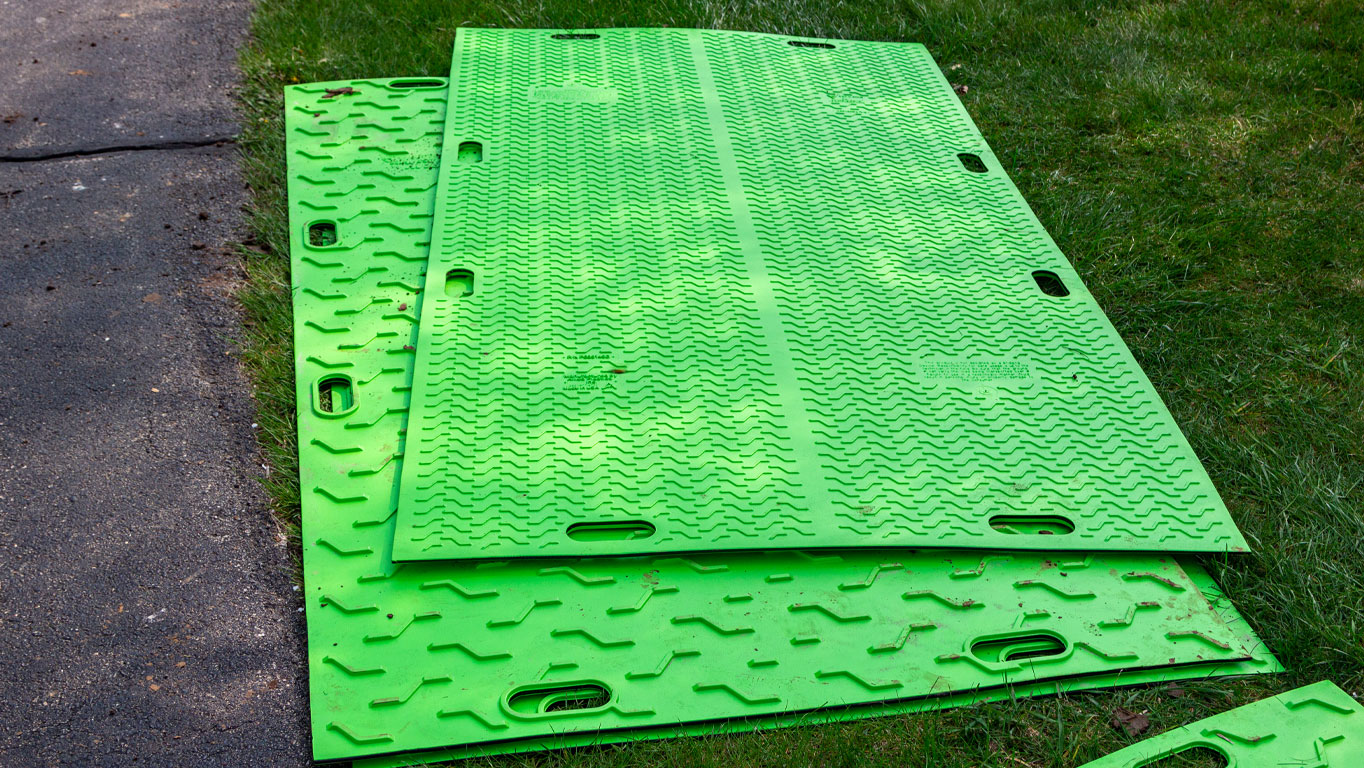
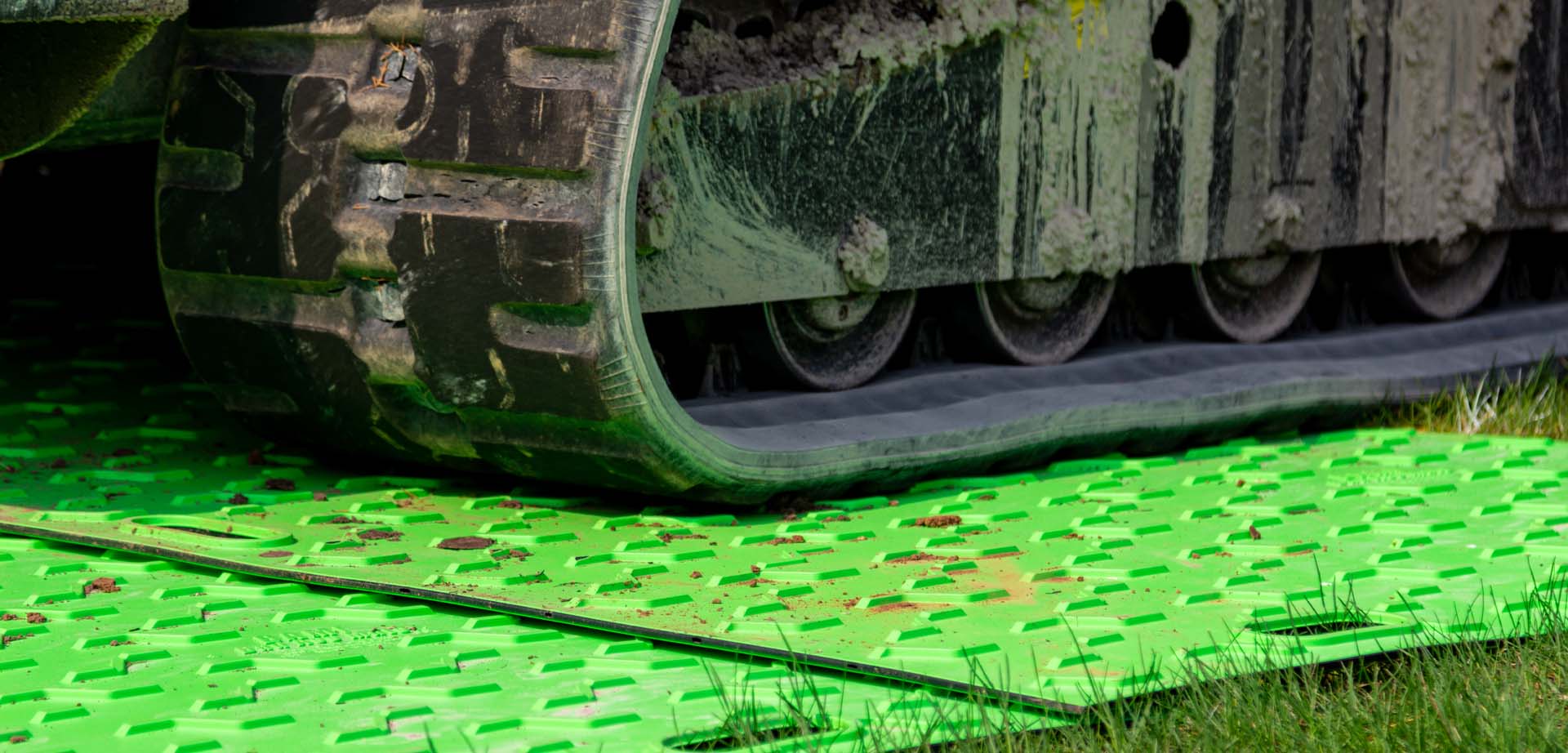
The most effective method for most residential and light commercial applications is sequential HDPE panel deployment: laying 4×8 rigid panels end-to-end to create a continuous, load-rated surface that equipment drives across.
When the job is done, the panels come up. The ground underneath is unchanged. There is no gravel to reclaim, no fill to remove, and no compacted roadbed to restore.
When Temporary Access Road Construction Is Required
Residential equipment access
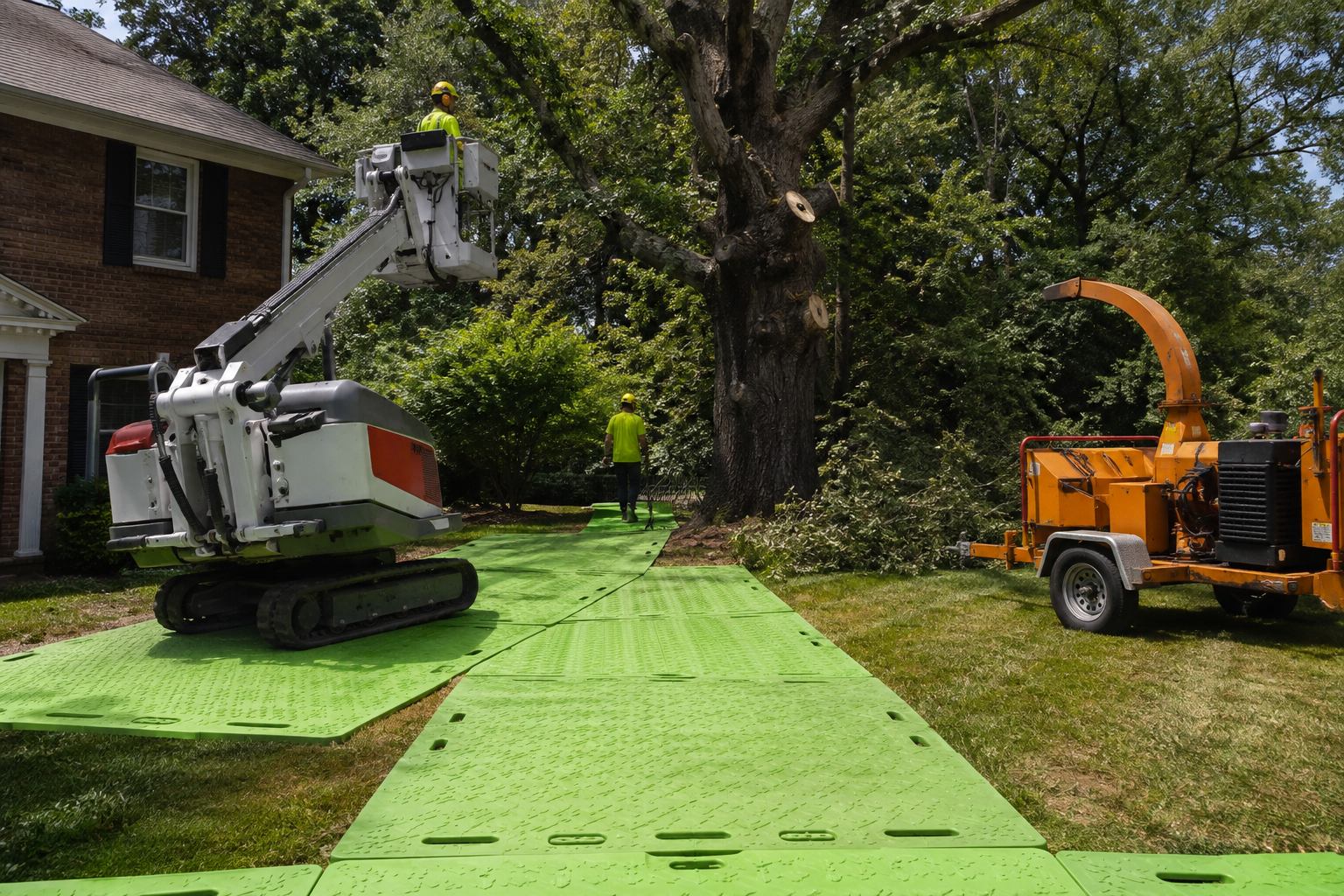
A landscaper needs to move a skid steer from the street trailer to the backyard. A pool contractor needs excavation equipment across the front lawn. A tree service needs a bucket truck within reach of a large backyard tree. All of these require a temporary access route across a surface—typically a residential lawn—that cannot handle direct equipment traffic.
Soft or saturated soil after rain
Ground conditions change rapidly after rain. A site that handled equipment access in dry conditions may be inaccessible after two days of rain. Temporary access road construction with HDPE panels restores equipment access on saturated ground without waiting for it to dry out.
Utility and infrastructure corridor access
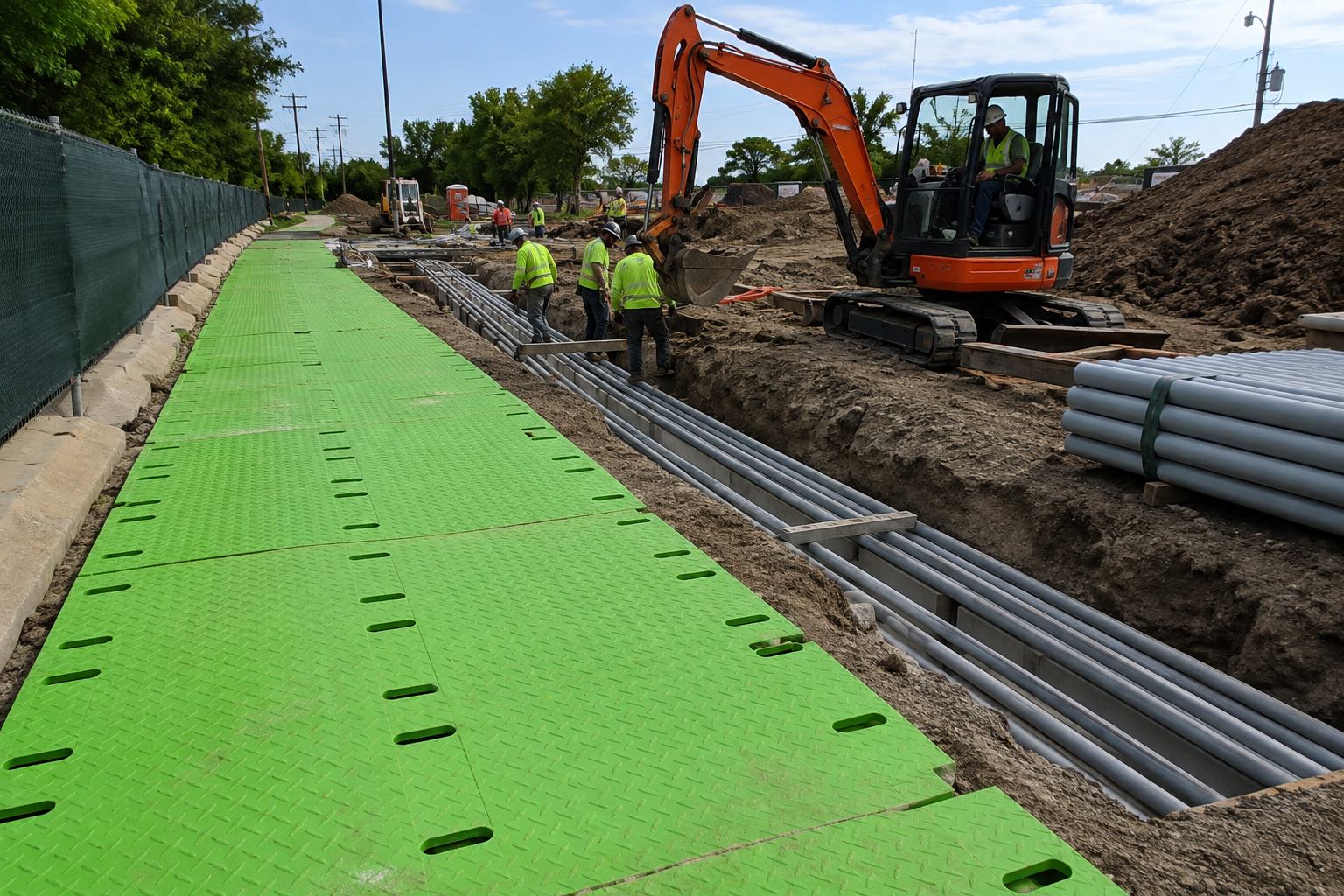
Utility crews working in easements, drainage corridors, and public rights-of-way often have explicit property restoration requirements. A temporary access road that leaves no trace satisfies these requirements in a way that gravel or tracked equipment cannot.
Commercial and event site access
Construction sites, event venues, and commercial properties all require equipment access across maintained grounds at various project phases. Temporary access roads can be established, relocated as the project progresses, and removed cleanly at completion.
Temporary Access Road Construction Step by Step
Step 1: Survey the route before a single mat goes down
Walk the full access route from the equipment staging position to the work zone. Note the surface type at each section—turf, driveway, patio, gravel, soft soil. Identify any sections where the ground is noticeably softer or wetter. Plan your panel configuration before deployment begins.
Step 2: Establish coverage from firm ground inward
Begin panel deployment from the firmest available surface—typically the street apron or the edge of an existing paved area—and work toward the work zone. Starting on firm ground gives the crew a stable working platform and allows conditions to be assessed as coverage advances toward softer sections.
Step 3: Use the flip-and-lay deployment sequence
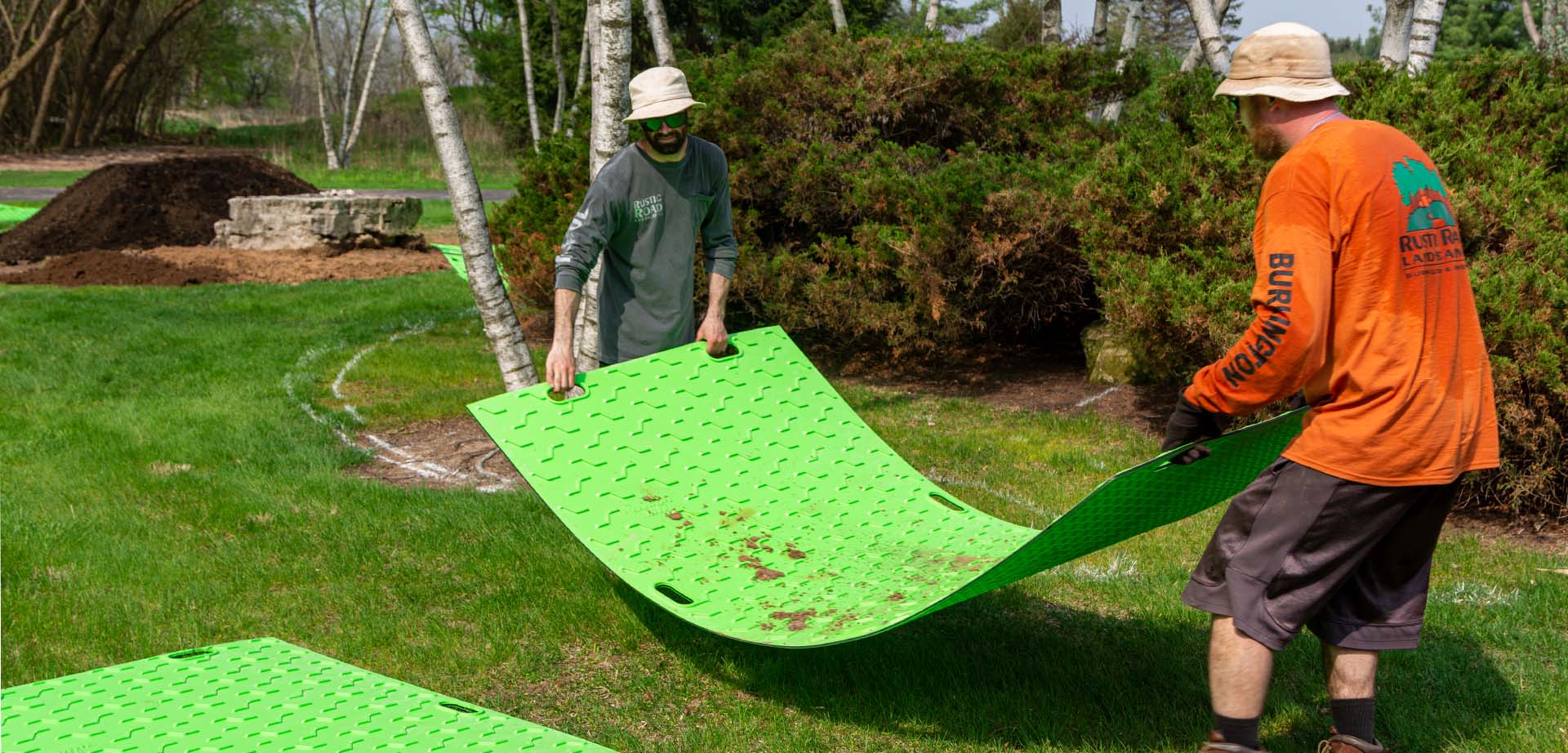
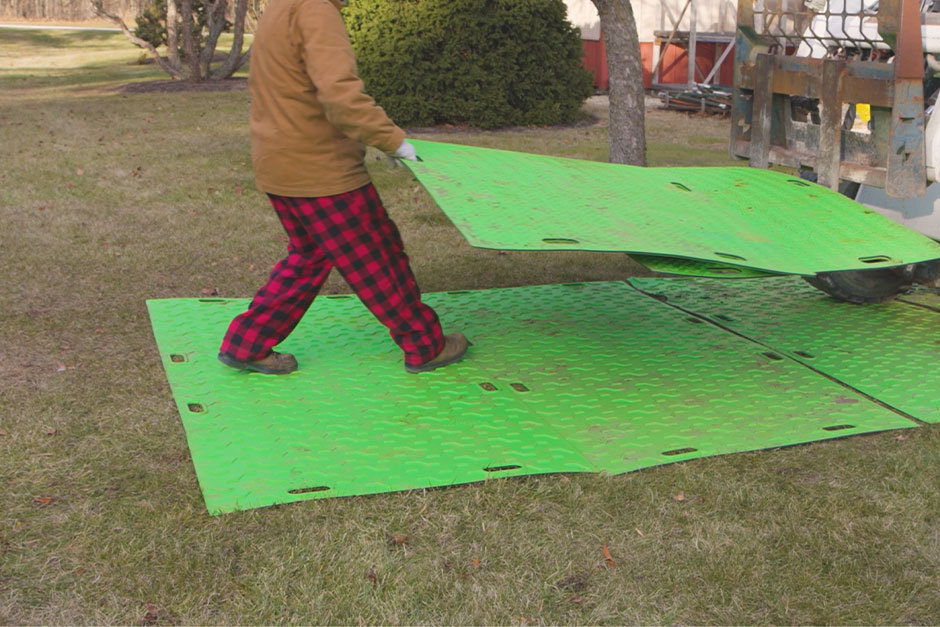
Place the first panel flat. Carry the next panel to the leading edge of the first panel and flip it into position. Advance to the leading edge and repeat. A two-person crew using this method can cover 100 linear feet of single-column access road in 10 to 15 minutes.
Step 4: Single column vs. double column
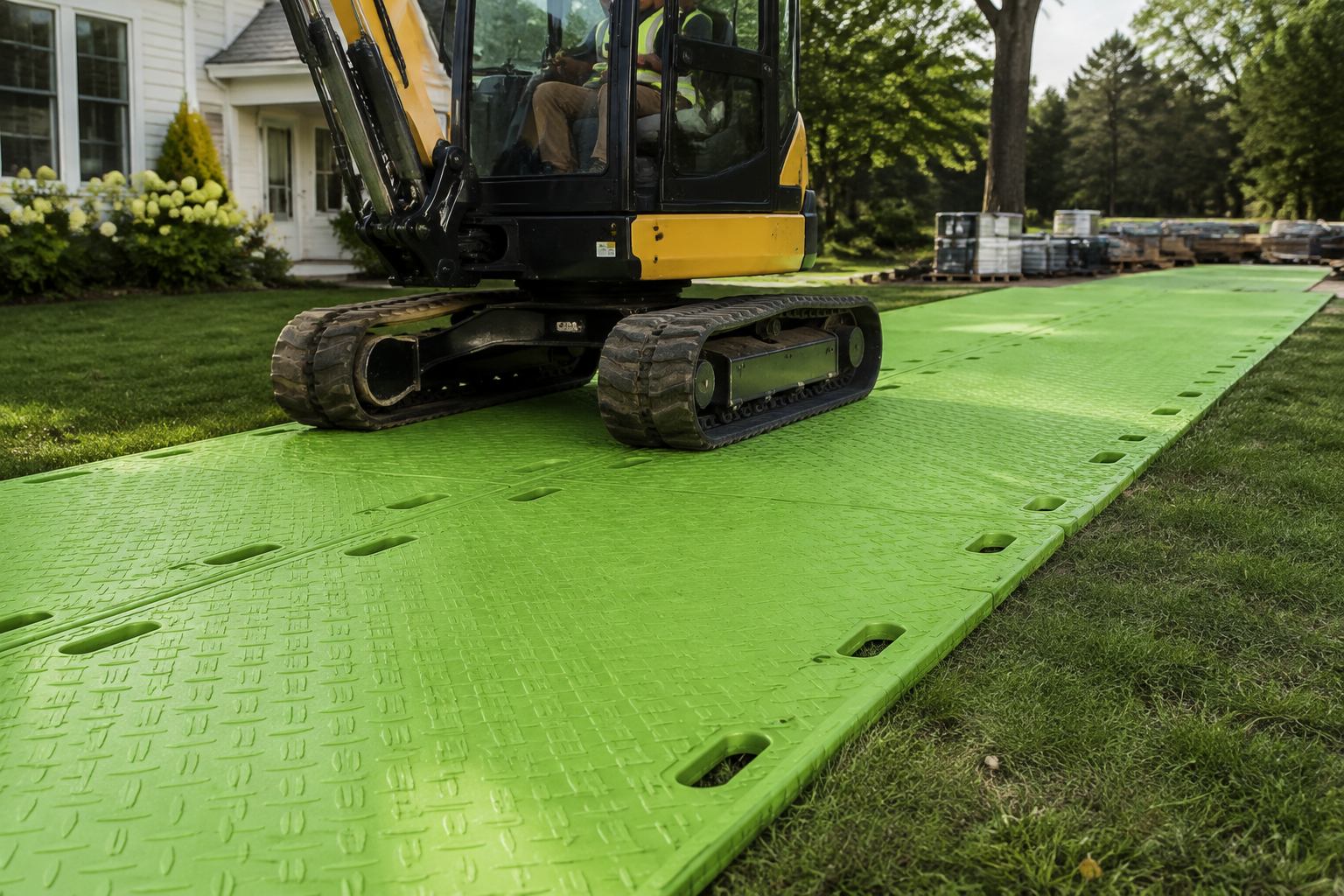
Single-column deployment (one 4×8 panel per 8 feet of route) works for foot traffic, light equipment, and narrow access passages. Double-column deployment (two panels side by side for an 8-foot-wide lane) is required for equipment wider than 4 feet—which includes most skid steers, compact loaders, and mini excavators.
Step 5: Reinforce soft sections and turning zones
Wherever the ground is softest or wherever equipment will turn, add extra panel coverage beyond the standard path width. These are the highest-stress points on the access route. Extra coverage here prevents the performance issues that show up exactly when equipment is most difficult to recover.
Step 6: Build the work zone staging pad
At the far end of the access route, construct a staging pad—a wider, fully covered area where equipment can position, turn around, and idle during the job. This zone takes more load per square foot than the travel path and needs proportionally more coverage.
Temporary Access Road Construction vs. Alternatives
vs. gravel access roads
Gravel roads require a dump truck to deliver material, a grader or skid steer to spread it, and a separate restoration operation to remove it. Timeline: half a day or more for installation alone. BAM! panel roads: 15 to 30 minutes for installation. Zero restoration required.
vs. timber access mats
Timber access mats handle enormous loads but weigh 300 to 500 pounds each—requiring a crane or forklift to install. BAM! HDPE panels at 56 pounds are single-person portable. For residential and light commercial temporary access road construction, timber mats are impractical.
vs. existing ground with no protection
Equipment directly on unprotected ground in soft or wet conditions is not a cost-saving option—it is a damage guarantee. Recovery costs for rutted lawns, damaged easements, and property restoration routinely exceed the cost of a full set of HDPE mats.
Temporary Roadway Systems: Planning for Longer Projects
Projects that run for weeks or months require temporary roadway systems that adapt as the project progresses. Key planning principles:
- Establish the primary access route at project start and maintain it throughout
- Keep a panel inventory on site that allows route adjustment without ordering delays
- Relocate panels when project phases shift the equipment access pattern
- Increase coverage at turning zones as the ground compresses under repeated use
- Inspect coverage after significant rain events and add panels where saturation has increased
Frequently Asked Questions
Q: How long can a temporary access road made of HDPE panels remain in place?
A: As long as the project requires. BAM! HDPE mats are not degraded by sun, rain, or temperature extremes. They can remain deployed for days, weeks, or months. For extended deployments on turf, periodically check the condition of grass underneath and shift coverage if needed.
Q: Can temporary access roads be used on public rights-of-way?
A: Yes. HDPE panels are appropriate for temporary access road construction in public rights-of-way, parks, and municipal grounds. They leave no trace on removal and meet property restoration requirements. Contact BAM! at 888-870-8158 for guidance on municipal applications.
Q: How many panels do I need for a 150-foot temporary access road?
A: A single-column 150-foot route needs approximately 19 panels. A double-column equipment route needs approximately 38 panels, plus additional panels for the staging pad at the far end. Call 888-870-8158 for site-specific sizing.
Q: Can BAM! panels be connected to each other to prevent gaps?
A: BAM! panels are placed edge-to-edge without mechanical connection. Their mass and tread grip keep them in position under equipment traffic. For added stability in high-wind or slope conditions, contact BAM! at 888-870-8158 for anchoring guidance.
Build the Road. Protect the Ground. Leave No Trace.
Temporary access road construction with HDPE panels is the fastest, cleanest way to move equipment across surfaces that cannot handle it unprotected. The road goes in before the equipment moves, stays through the job, and comes up leaving the ground unchanged.
Plan your temporary access road at bamgroundpro.com/products. Find a distributor at bamgroundpro.com/where-to-purchase. Contact us at bamgroundpro.com/contact-us, call 888-870-8158, or email msheridan@alliedplastics.com. Work cleaner. Work safer. Pro’s choose BAM!