Every contractor has experienced it. You finish the job, the customer walks out to inspect the work—and the first thing they notice isn’t the roof, the landscaping, or the remodel. It’s the cracked driveway. The scuffed pavers. The tire tracks pressed into fresh concrete.
Plywood seemed like the right call. It usually does. Until it doesn’t.
Heavy duty driveway mats exist to close that gap permanently. They’re what serious contractors—the ones who don’t get damage complaints—are using on every job that involves a driveway. This post explains exactly why, what to look for, and how to set them up right.
Why Driveways Take So Much Abuse on Contractor Jobsites
Driveways are where everything happens on a residential job. Delivery trucks back in. Dumpsters get staged. Crew vehicles park for hours. Equipment rolls across the apron. Material gets stacked, moved, and stacked again.
What makes driveways vulnerable isn’t just weight—it’s the combination of weight, point pressure, heat, and repetition.
Concrete cracks from concentrated loads
A standard residential concrete driveway is designed for passenger vehicles—roughly 4,000 to 6,000 pounds. A loaded dumpster exceeds 20,000. A delivery truck with shingles can approach 40,000. Even a mid-size skid steer at 10,000 pounds applies that load through a small contact area, creating point pressures that exceed what the concrete can handle.
Asphalt scuffs and deforms in heat
Summer asphalt softens. A heavy piece of equipment or a delivery truck sitting in one spot on a warm afternoon can permanently deform the surface. And turning equipment—especially skid steers—leaves scuffs that don’t come out.
Pavers shift and crack
Decorative pavers are especially vulnerable. They’re installed on a sand or gravel base, and point loads from heavy equipment shift that base. Once a paver shifts or cracks, the whole pattern is compromised. Repairs are expensive and almost never look perfect.
What Makes Plywood Fail as a Driveway Protector
Plywood has one thing going for it: it’s cheap up front. But on actual jobsites, it fails in ways that end up costing contractors far more than they saved.
- Absorbs moisture and warps within days of use
- Cracks and splinters under heavy equipment—especially once wet
- Becomes a slip hazard for crew in wet conditions
- Leaves behind stains, splinters, and debris on client driveways
- Requires repeated replacement—2 to 3 uses before disposal is common
- Looks unprofessional on high-value properties
The math is straightforward: plywood looks cheaper per sheet but costs more per use once replacement frequency is factored in. And a single property damage claim erases months of savings.
What Heavy Duty Driveway Mats Are Built to Do
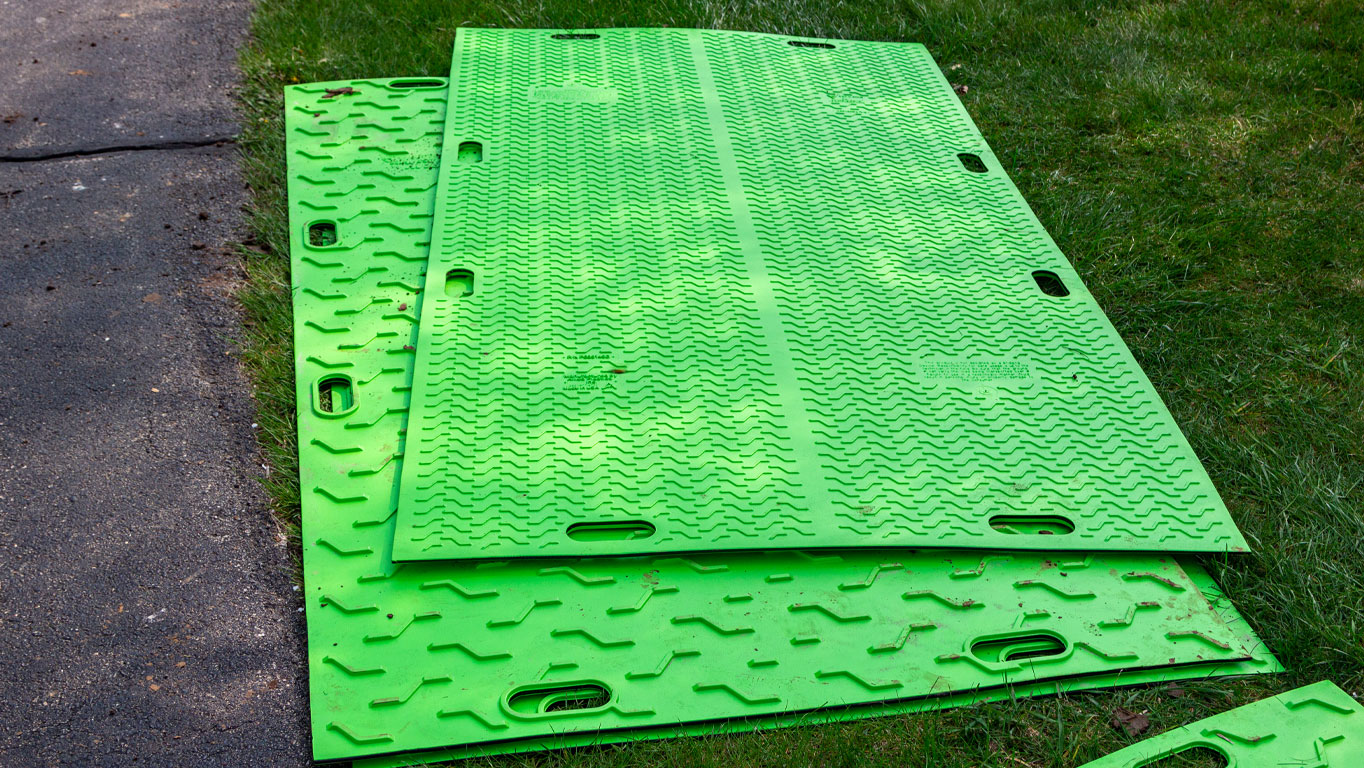
Real heavy duty driveway mats are engineered for the conditions plywood can’t handle. BAM! Bad Ass Mats are made from 3/8-inch thermoformed HDPE—a material that doesn’t absorb water, doesn’t rot, doesn’t splinter, and doesn’t crack under load.
The 80-ton weight rating
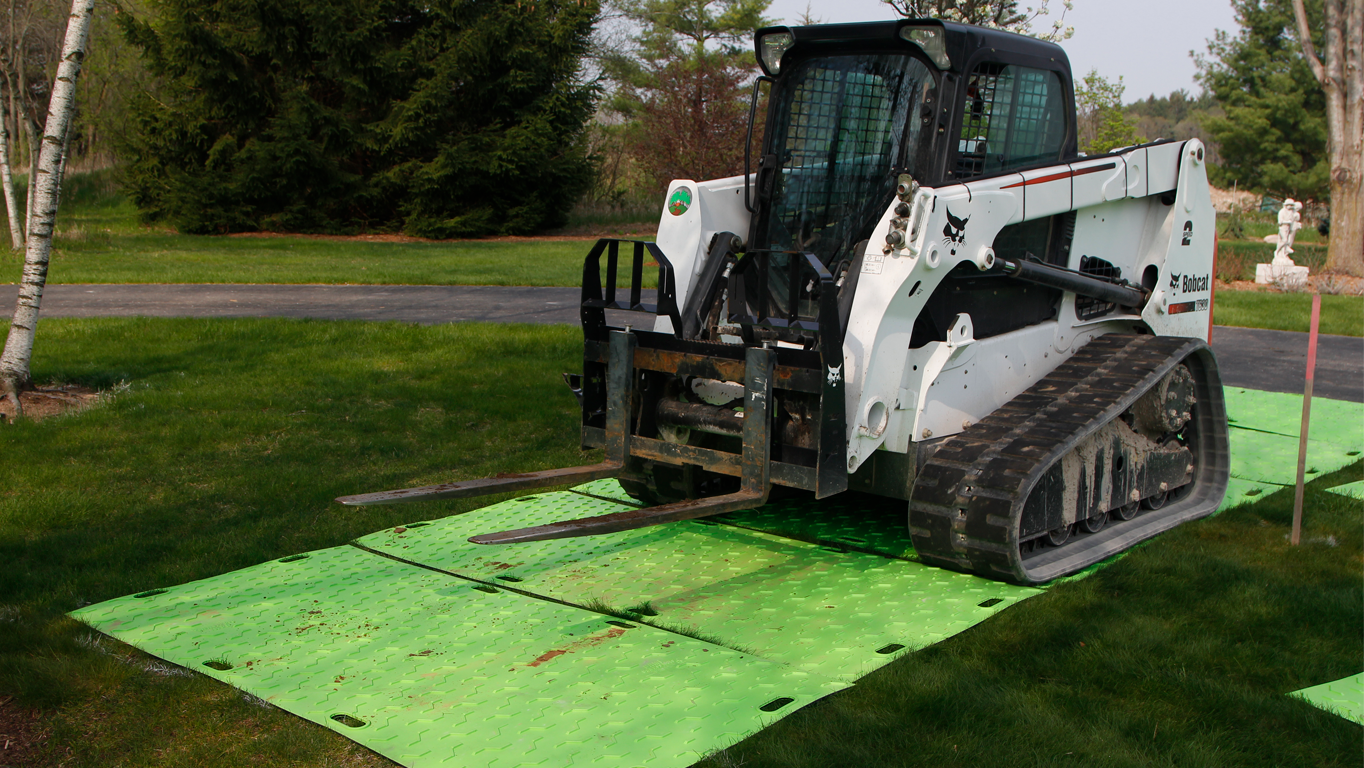
BAM! mats are rated to 80 tons. That’s 160,000 pounds. The heaviest residential equipment contractors typically use—fully loaded dumpsters, roofing delivery trucks, skid steers—falls well within that margin. You’re not working near the limit. You’re working with enormous safety headroom.
Dual-sided tread for equipment and crew
The equipment side of a BAM! mat is designed for tire grip—machines move smoothly without slipping or tearing up the mat. The pedestrian side gives crew members solid footing during setup and throughout the job. Both surfaces matter on every driveway job.
56 pounds per 4×8 sheet
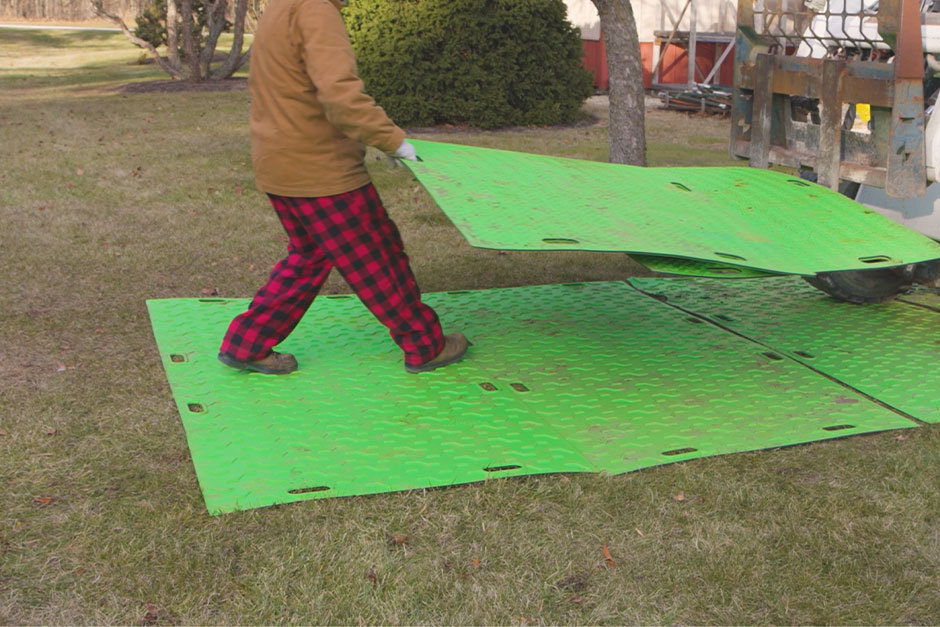
At 56 pounds, a single crew member can carry and position a 4×8 panel without strain. That means faster setup and teardown without needing an extra person. On jobs where time is money—and every job is—that efficiency compounds across an entire day.
Made in the USA, 3-year warranty
BAM! mats are designed, engineered, and manufactured by Allied Plastics at an ISO 9001:2015 certified facility in Twin Lakes, Wisconsin. Every mat comes with a 3-year warranty—because that’s how durable they are.
How to Set Up Heavy Duty Driveway Mats the Right Way
Dropping mats on a driveway randomly doesn’t give you full protection. A smart layout matters.
Cover the full approach zone
Start from where the truck or equipment makes contact with the driveway—the apron at the street—and run mats all the way to the work zone. This isn’t just about protecting one spot. It’s about protecting the whole path.
Extend beyond the equipment footprint
Mats should extend at least 12 inches beyond the planned footprint of any staged equipment or dumpster. Positioning isn’t always exact, and you want full coverage even if placement shifts slightly.
Use 2×8 panels for tight areas
Side yards, narrow aprons, and tight driveways may not accommodate full 4×8 panels side by side. The 2×8 size gives you the flexibility to build coverage through narrow access areas without sacrificing protection.
Protect the edges
Driveway edges—especially on older concrete—are the most vulnerable to cracking. Make sure mat coverage extends to the edge of the surface wherever equipment will travel.
Which Jobs Need Heavy Duty Driveway Mats Every Time
Roofing
Dumpster placement, delivery trucks, and repeated crew traffic make roofing one of the highest-risk jobs for driveway damage. No exceptions.
Landscaping
Skid steers, compact loaders, and material deliveries all cross residential driveways on landscaping jobs. The damage happens fast on decorative concrete and pavers.
Remodeling and additions
Long projects mean repeated traffic over weeks. Driveway protection needs to be consistent throughout every phase.
Pool and excavation work
Heavy excavation equipment and concrete trucks apply loads that driveways are not designed for. Mats are essential, not optional.
Utility and HVAC service
Even service vehicles with equipment mounted in the bed apply enough point load on driveway edges to cause cracking over time.
The Business Case: Mats Pay for Themselves Fast
A set of BAM! mats used across 40 jobs over a season costs a fraction of a single driveway repair. And driveway repairs on high-value properties aren’t cheap—concrete crack repair runs $300 to $800. Paver replacement can run into the thousands.
Beyond direct repair costs, damage claims cost time: scheduling, follow-up visits, dealing with upset clients, and the review that doesn’t get written—or worse, the one that does.
Mats eliminate that risk. And they last years, not days.
Frequently Asked Questions
Q: How heavy is a BAM! 4×8 heavy duty driveway mat?
A: Each 4×8 BAM! mat weighs 56 pounds—about half the weight of comparable reusable mats. That’s light enough for a single crew member to carry and position without assistance, even in gloves.
Q: Can heavy duty driveway mats protect decorative pavers?
A: Yes. HDPE mats distribute weight across the full panel surface, which prevents the point loads that crack and shift individual pavers. They’re specifically effective on sand-set paver installations that are sensitive to lateral pressure.
Q: How many mats do I need for a standard residential driveway job?
A: It depends on the job. A dumpster placement typically requires 4 to 6 4×8 panels. A full driveway protection setup for a roofing job with a delivery truck and dumpster can require 8 to 12 panels. Contact BAM! at 888-870-8158 and we’ll help you plan the right quantity.
Q: How do I clean HDPE mats after a job?
A: HDPE cleans easily. Remove loose debris, then rinse with water. For heavier mud and concrete residue, a pressure washer handles it quickly. Mats are ready to stack and reuse immediately after cleaning.
Q: Are these mats available through local distributors?
A: Yes. BAM! mats are available through a national distributor network. Visit the Where to Purchase page at bamgroundpro.com or call 888-870-8158 to find the closest distributor to your location.
Stop Gambling with Client Driveways
Every job that involves a driveway is a risk—unless you protect it properly. Plywood isn’t protection. It’s a temporary patch that creates new problems.
BAM! Bad Ass Mats are available through distributors nationwide. Visit bamgroundpro.com/products to explore full product specs, find a distributor at bamgroundpro.com/where-to-purchase, or reach out directly at bamgroundpro.com/contact-us. Call us at 888-870-8158 or email msheridan@alliedplastics.com. Pro’s choose BAM!