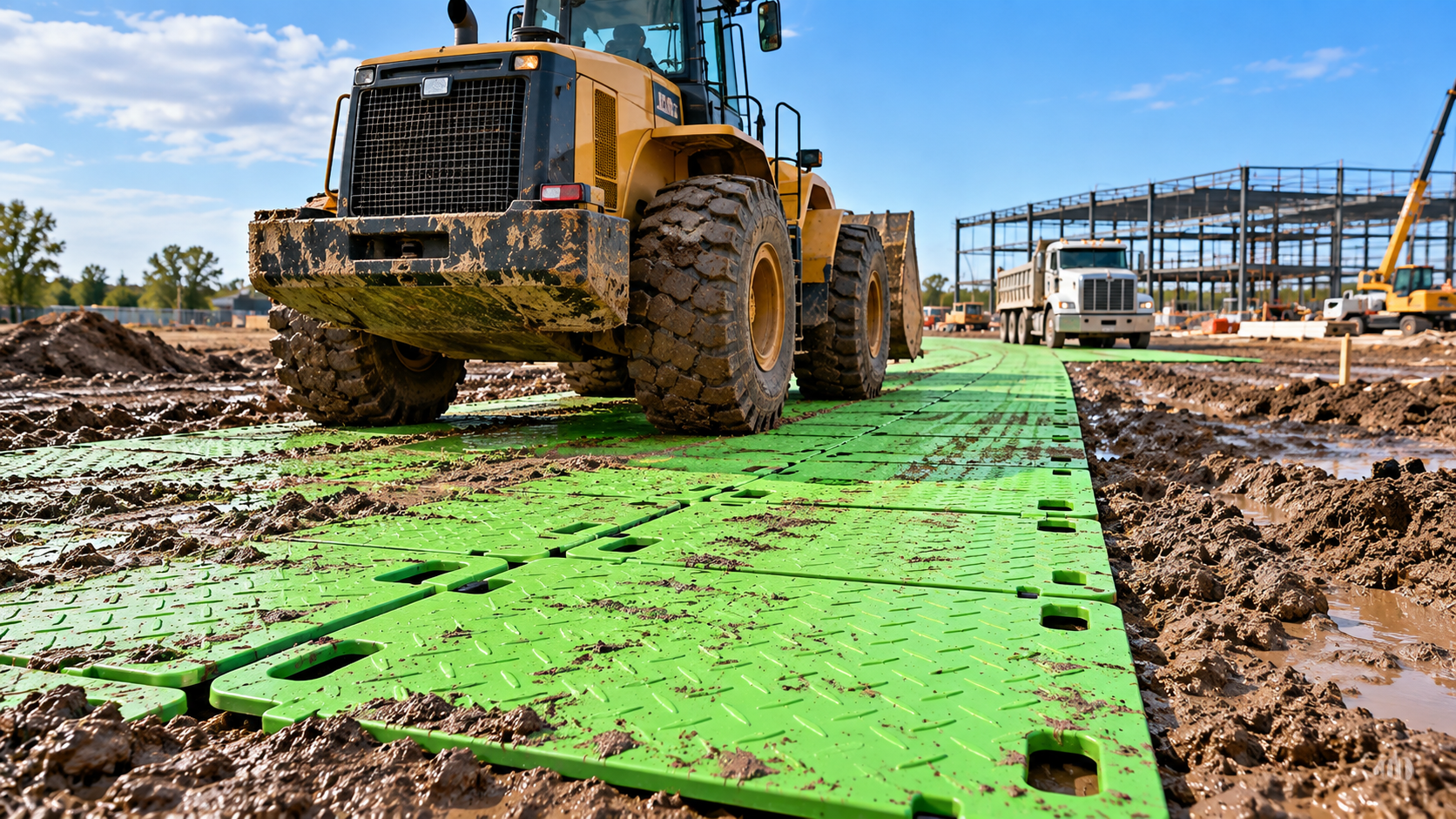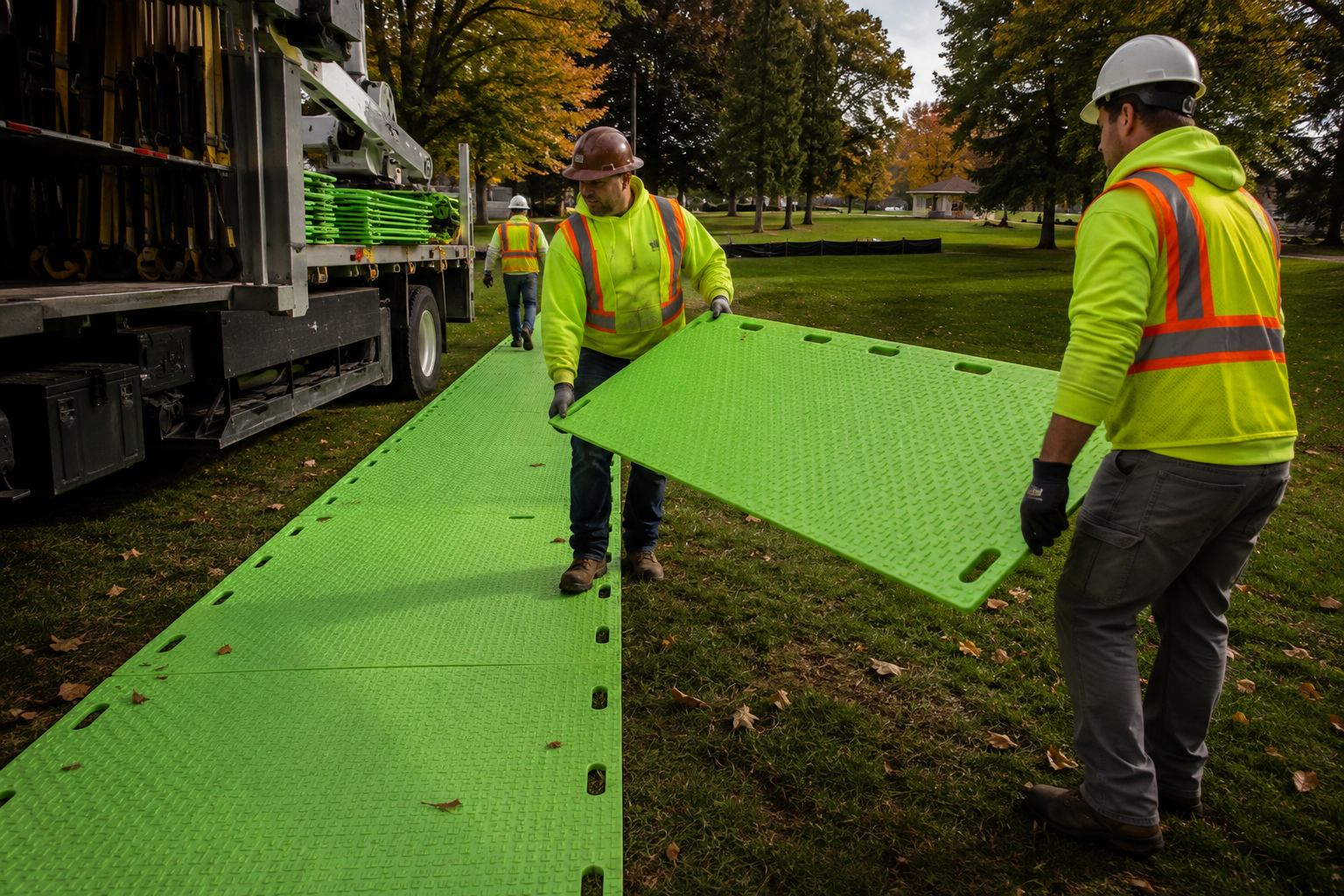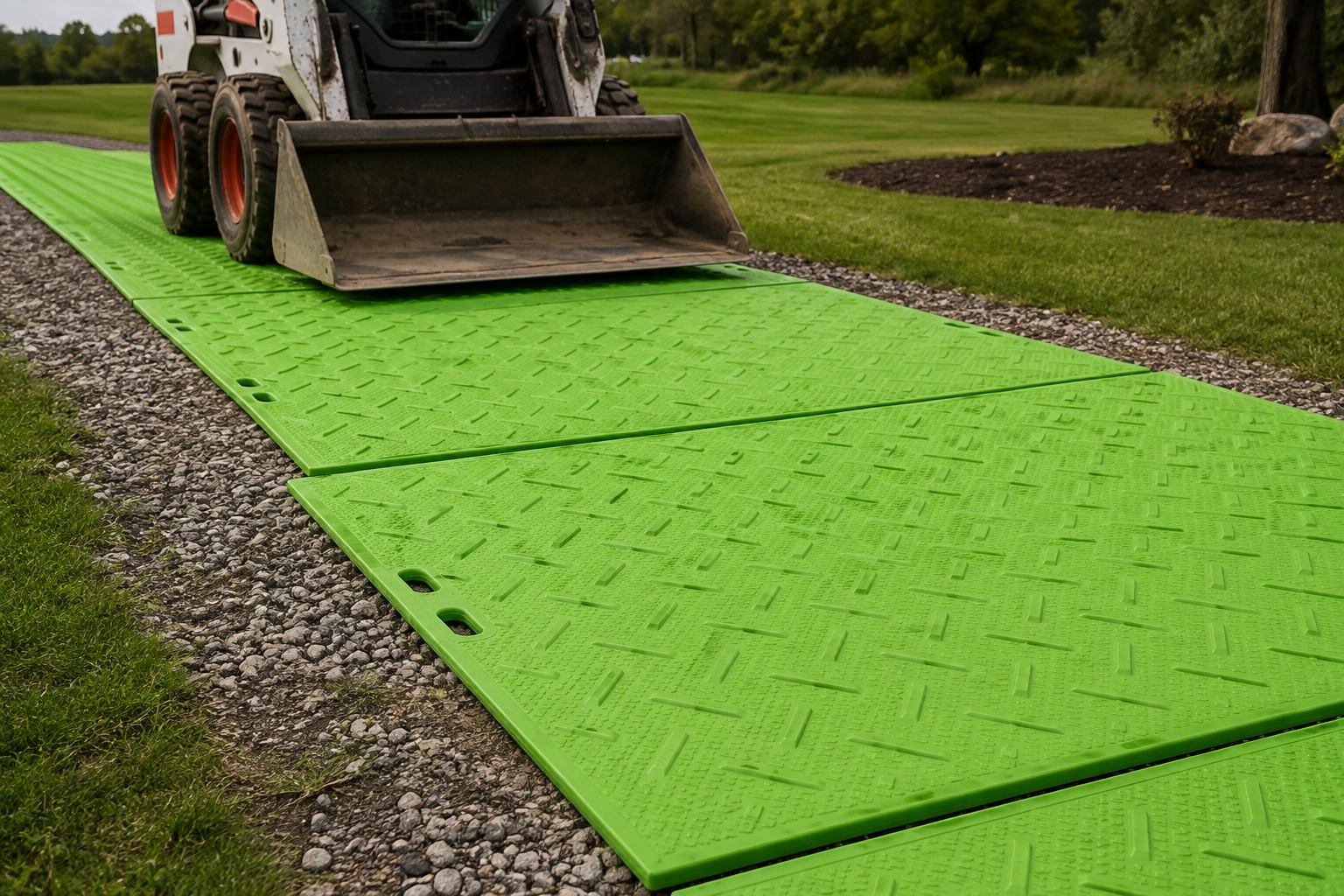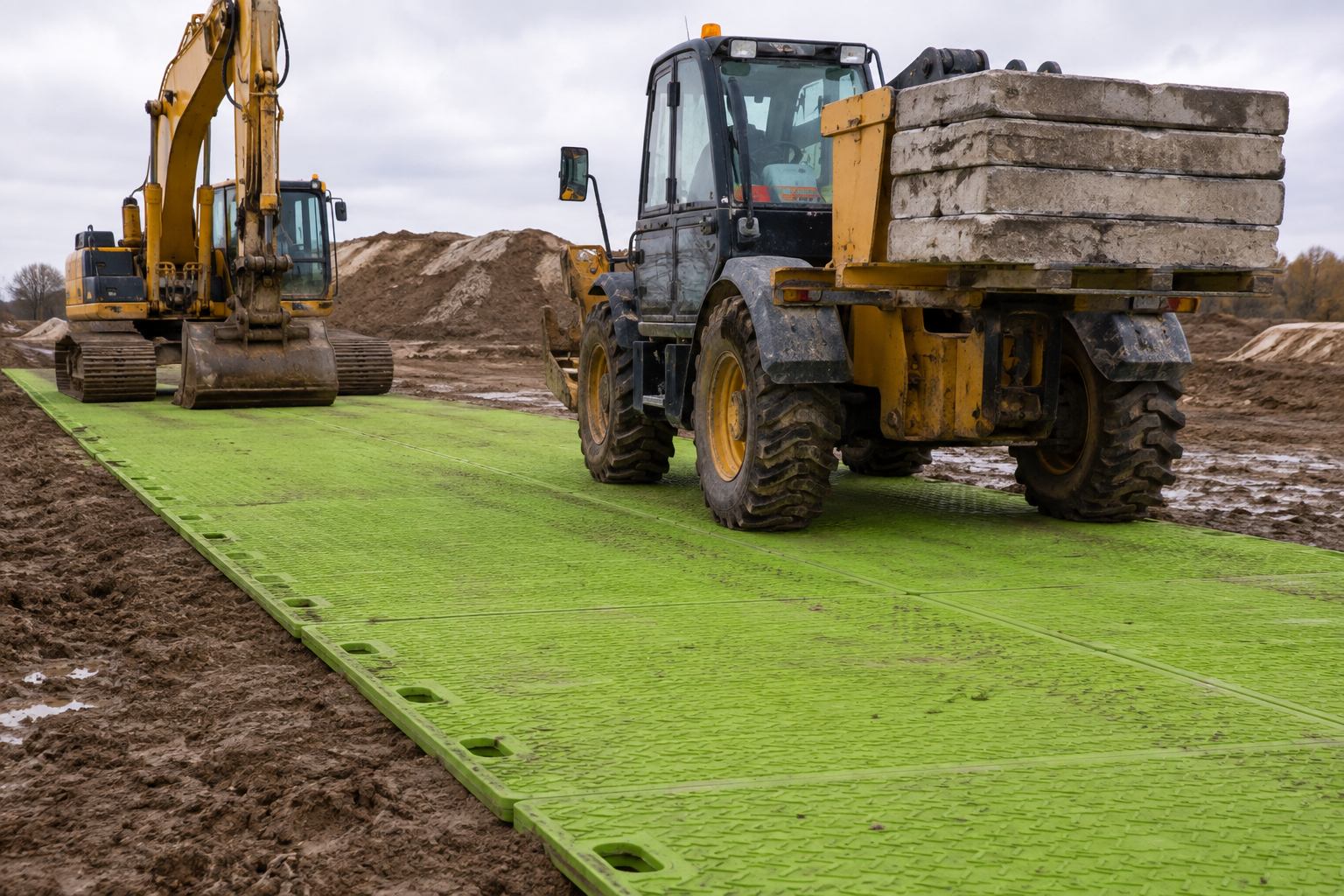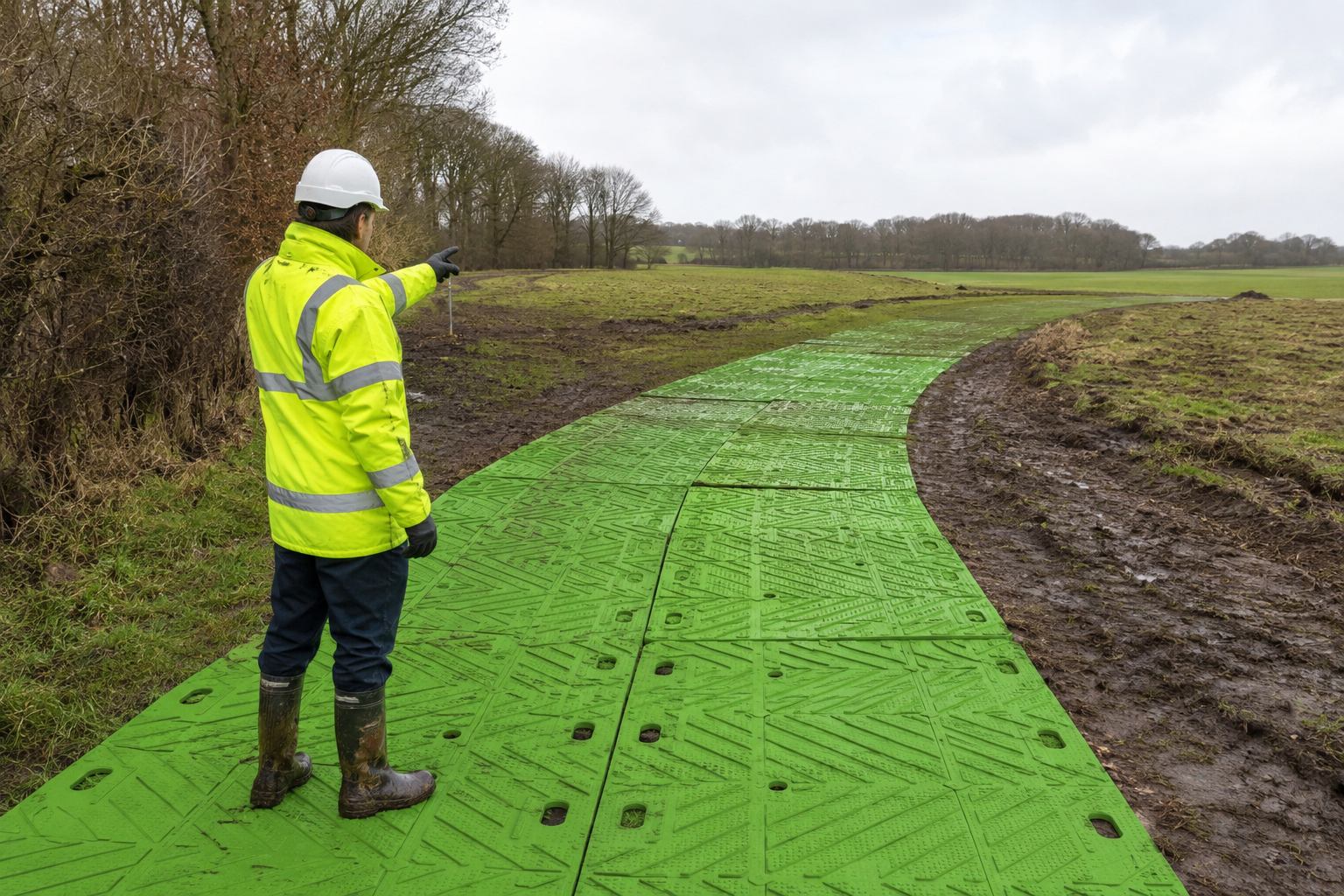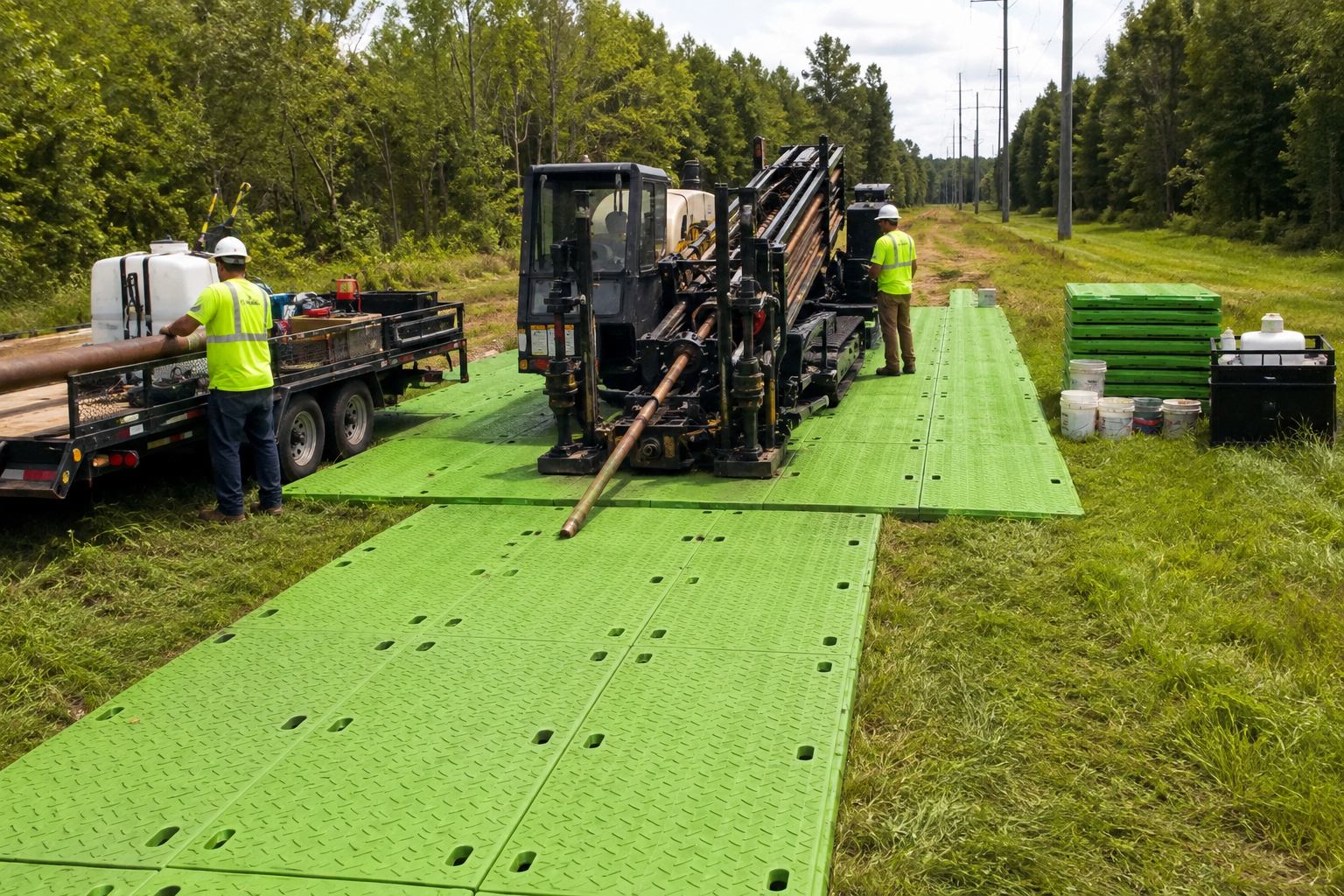

Walk into any equipment supply discussion and you will hear plastic, HDPE, and composite thrown around almost interchangeably. They are not the same thing. The differences between them show up in load ratings, lifespan, handling weight, cost per use, and what happens to a mat when a 20,000-pound machine crosses it on a wet day.
This guide makes the comparison clear so contractors can choose the right product for the work they actually do.
Understanding the Category Labels
‘Plastic’ mats: the broadest and least useful label
‘Plastic’ is a category containing dozens of different polymer types with dramatically different mechanical properties. Low-density polyethylene (LDPE), polypropylene (PP), PVC, and high-density polyethylene (HDPE) are all plastics. Their performance varies enormously.
When a product is marketed as a ‘plastic mat’ without specifying the polymer type, that’s a warning sign. Specific material identification—HDPE, polypropylene, etc.—indicates a manufacturer willing to stand behind a defined product specification.
HDPE mats: a specific material with known properties
High-density polyethylene is a well-characterized engineering material with documented properties: tensile strength of 2,600 to 3,500 psi, flexural modulus around 200,000 psi, excellent chemical resistance, near-zero moisture absorption, and consistent performance from -40°F to 176°F.
These properties translate directly to ground protection performance: HDPE panels hold their shape under load, resist moisture without absorbing it, maintain traction in temperature extremes, and don’t crack from freeze-thaw cycling.
Composite mats: a broad category of mixed materials
Composite ground protection mats combine two or more materials—most commonly fiberglass-reinforced polymer, carbon fiber composite, or wood fiber-polymer blends. Premium composites can achieve excellent strength-to-weight ratios. Budget composites may use filler materials that compromise performance under sustained load and moisture exposure.
Quality within the composite category varies more than within the HDPE category, because the composite formulation is proprietary to each manufacturer.
Head-to-Head: The Metrics That Matter
Load rating
This is the most critical specification for contractors running heavy equipment. BAM! HDPE mats carry an 80-ton rating from ISO 9001:2015 certified manufacturing. Generic ‘plastic’ mats often carry no stated load rating or ratings of 5 to 20 tons. Premium composites can match HDPE ratings but at higher cost.
For contractors running skid steers (up to 12,000 lbs), mini excavators (up to 15,000 lbs), delivery trucks (up to 60,000+ lbs), and dumpsters (up to 30,000 lbs), the 80-ton BAM! rating provides extensive safety margin that unrated or low-rated ‘plastic’ mats cannot match.
Weight per panel
BAM! HDPE 4×8 panel: 56 lbs. Generic plastic or composite 4×8 equivalent: typically 80 to 130 lbs. This weight difference determines whether a single crew member can deploy mats or whether deployment requires two people. On busy jobsites deploying 10 to 20 panels multiple times per week, that labor efficiency difference is substantial.
Moisture performance
HDPE: near-zero moisture absorption. Performance identical whether dry or fully submerged. Generic plastics with filler materials: can absorb moisture, which weakens the material over time and causes dimensional change (warping, swelling) that affects traction and stacking. Composites with wood fiber content: absorb moisture, swell, and can delaminate under repeated wet-dry cycling.
UV resistance
HDPE: excellent UV resistance with minimal performance degradation over years of outdoor storage. Generic plastics: UV resistance varies significantly by formulation—some budget plastics become brittle within 1 to 2 years of outdoor use. Composites: dependent on the specific matrix and fiber combination.
Lifespan and cost per use
Generic plastic mats: 1 to 3 years of active use; replacement required. BAM! HDPE mats: 5 to 10+ active years; 3-year warranty; cost per use decreases with every additional deployment. Premium composites: comparable lifespan to quality HDPE but typically at higher initial cost.
When Generic Plastic Mats Are Adequate
Budget plastic mats have applications where their limitations are acceptable:
- Light foot traffic areas with no equipment exposure
- Single-use event applications where low cost is the primary driver
- Applications where the load is consistently light (under 5 tons) and soil conditions are stable
For any application involving equipment over 5 tons, repeated use, all-weather deployment, or professional contractor use, generic plastic mats are a false economy.
When HDPE Is the Right Choice
HDPE mats are the right choice for professional contractor use across every application category:
- Residential and commercial equipment access (skid steers, excavators, loaders)
- Dumpster placement and material delivery protection
- Temporary access road construction
- All-season four-weather operation
- Jobs requiring consistent professional presentation
- High-value residential and commercial property protection
The BAM! HDPE Advantage
Within the HDPE category, BAM! Bad Ass Mats differentiate through manufacturing precision and design features that generic HDPE panels don’t offer:
Thermoformed construction: consistent density and dimensional stability across every panel—no variation between batches
Dual-sided tread: equipment grip on one side, pedestrian traction on the other—unique to BAM! in the market
56-pound weight: lighter than virtually all comparable HDPE panels while maintaining 80-ton rating
ISO 9001:2015 certified: manufacturing quality standard that produces verifiable, consistent product
USA-made: Allied Plastics, Twin Lakes, Wisconsin—domestic lead times, direct manufacturer warranty support
Frequently Asked Questions
Q: Is HDPE more expensive than generic plastic mats upfront?
A: Yes. HDPE mats typically cost more per panel than budget plastic alternatives. But over a season of regular use, the cost per use of HDPE mats is lower—because they last far longer. One season of replacing cheap plastic mats typically costs more than one set of quality HDPE mats that will last years.
Q: Are composite mats stronger than HDPE?
A: Premium composites can achieve high strength-to-weight ratios, but this performance typically comes at a higher cost than HDPE. For the load range of residential and light commercial equipment, HDPE’s 80-ton rating provides adequate capacity without the premium composite price.
Q: How do I identify HDPE vs. generic plastic in a product I’m evaluating?
A: Ask the supplier for the specific polymer type, the material grade (density), and the load rating test methodology. Reputable HDPE mat manufacturers will provide all three. If a supplier cannot or will not specify the material type and load rating methodology, that is a signal about product quality.
Q: Where can I buy BAM! HDPE ground protection mats?
A: Visit bamgroundpro.com/where-to-purchase to find your nearest BAM! distributor, or call 888-870-8158.
Buy the Material That Matches the Job
Plastic, HDPE, and composite all have a place in the market. For contractors who run equipment on residential and commercial properties, HDPE is the material that delivers the load rating, the durability, and the handling weight that professional ground protection demands.
See BAM! HDPE ground protection mats at bamgroundpro.com/products. Find a distributor at bamgroundpro.com/where-to-purchase. Contact us at bamgroundpro.com/contact-us, call 888-870-8158, or email msheridan@alliedplastics.com. Pro’s choose BAM!