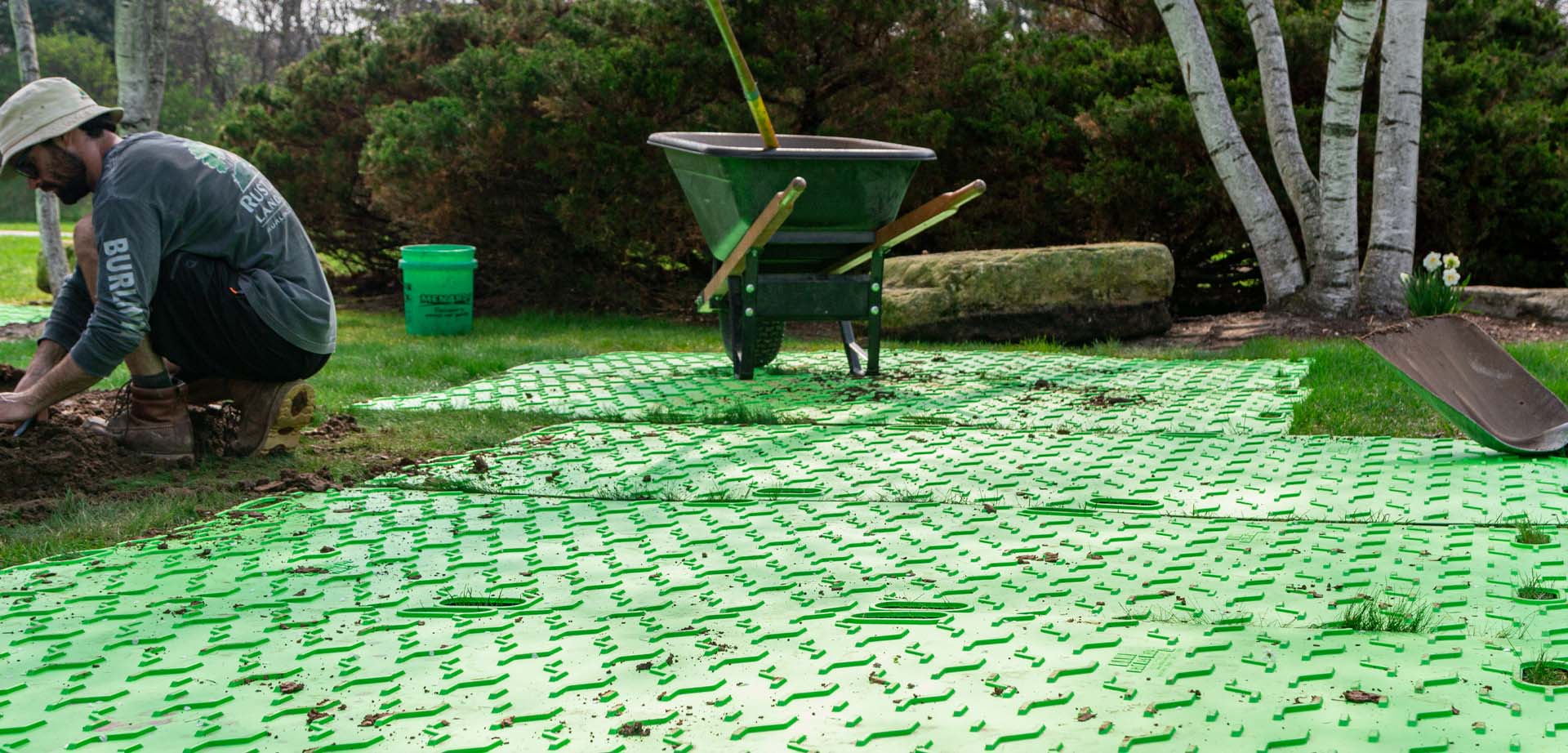
Getting heavy equipment from the street to the worksite is one of the most underestimated logistics challenges on a construction or landscaping job. When the path crosses turf, soft soil, gravel, or a residential driveway, the wrong approach turns an access problem into a property damage problem.
Road mats for heavy equipment solve this. They build a reliable, stable route that handles real machine loads—without tearing up what’s underneath.
The Access Problem on Real Jobsites
Every equipment-intensive job has an access challenge. Sometimes it’s crossing a customer’s lawn. Sometimes it’s navigating a narrow side yard. Sometimes it’s reaching a backyard that’s 150 feet from the street through a gate that’s barely wider than the machine.
The cost of getting access wrong is always higher than the cost of protecting it. A single equipment pass across unprotected turf in spring conditions can leave ruts that take a season to recover. An unprotected driveway crossing adds a repair bill to every delivery.
What Makes a Road Mat Suitable for Heavy Equipment
Load rating that matches the machine
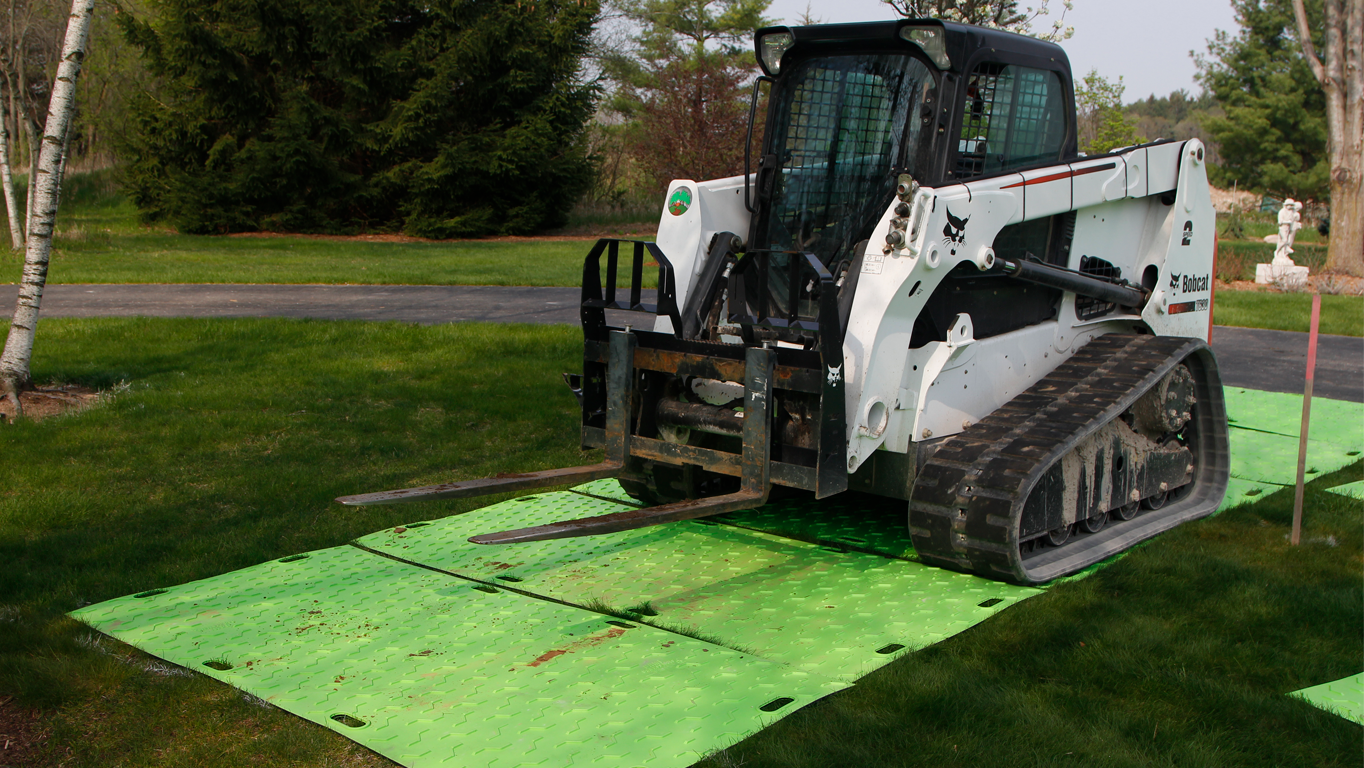
Equipment weights vary widely. A compact track loader runs 8,000 to 12,000 pounds. A mini excavator might reach 15,000 pounds. A skid steer with a loaded bucket can approach 12,000 to 14,000 pounds. A mat rated below these weights offers false protection.
BAM! Bad Ass Mats carry an 80-ton rating—160,000 pounds. No residential or light commercial equipment comes close to this limit. Working well within the rating means consistent performance and predictable behavior under load.
Surface area for load distribution
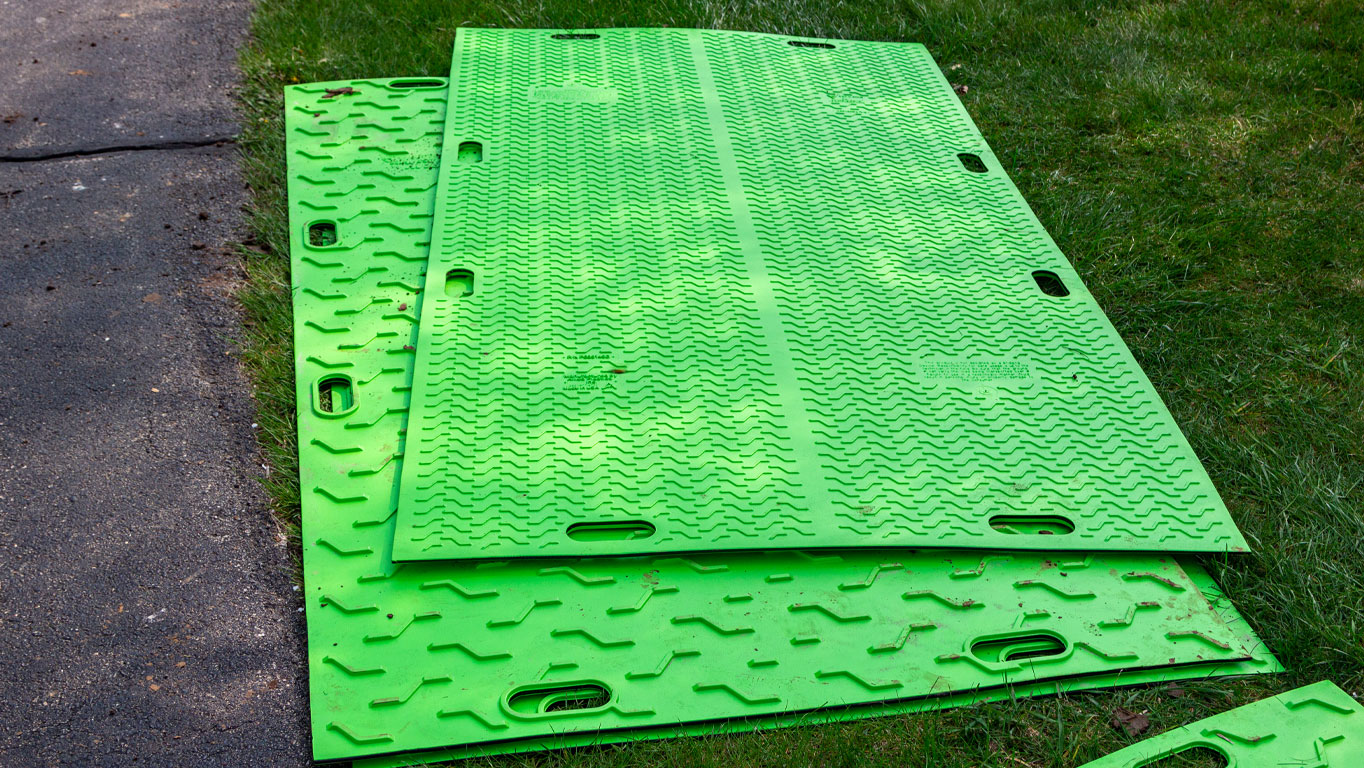
Load distribution is the core function of road mats. A 4×8 panel spreads load across 32 square feet. The more surface area under the equipment, the lower the pressure per square foot on the ground below. This is why coverage matters—a mat that doesn’t extend under the full equipment footprint creates edge conditions where load concentrates.
Traction for machines moving at work speed
Equipment doesn’t move slowly on access routes. Operators run at working speed. A mat surface that shifts or provides inconsistent traction creates handling issues—especially on slopes or turns. BAM!’s equipment-side tread is designed specifically for machine grip across varying conditions.
Access Route Layouts for Common Equipment Types
Skid steer access routes
Skid steers are roughly 5 to 6 feet wide. A double-column 4×8 mat path (8 feet wide) gives comfortable margin for the machine’s track width. Run the route from the trailer position to the first work zone, including any transitions from pavement to turf.
Mini excavator access routes
Mini excavators have tracks wider than their base width. Plan for the full track spread, not just the machine body. A standard double-column path is typically sufficient for mini excavators under 6 tons.
Compact track loader access
Compact track loaders (CTLs) are some of the heaviest machines contractors deploy. Full panel coverage across the route—double column minimum—with extra panels at turning points where the machine pivots and applies lateral force.
Boom lift and scissor lift access
Lift equipment applies load differently than tracked equipment. When outriggers are deployed, the load concentrates in the outrigger pad footprint. Place additional panels under each outrigger position, not just along the travel path.
Terrain-Specific Access Strategies
Residential lawn access
Residential lawns are the most common access challenge and the most visible when it goes wrong. Wet spring conditions make soil especially vulnerable—a single equipment pass can leave ruts 6 to 8 inches deep. Cover the full access route before the equipment moves, starting at the point where it transitions from pavement to turf.
Side yard and gate access
Many residential jobs require equipment to pass through a side yard gate. Gates are typically 36 to 48 inches wide—narrower than a standard 4-foot mat panel. This is where 2×8 panels (24 inches wide) become essential. Use 2×8 panels through the gate and transition to double-column 4×8 panels once the opening widens.
Utility easement access
Utility and HDD crews work in easements that are often narrow, unpaved, and adjacent to planted areas or landscaping. A single-column mat path in narrow easements, transitioning to staging zone coverage at the drill head location.
Soft soil after rainfall
Soil bearing capacity drops dramatically after rain. A route that handles equipment in dry conditions may churn badly after a rain event. Standard practice for wet conditions: double the planned coverage and add panels at any section where equipment will pause or pivot.
Connecting Multiple Mat Runs
Longer access routes require connecting multiple sets of panels. The key principle: maintain continuous coverage without gaps.
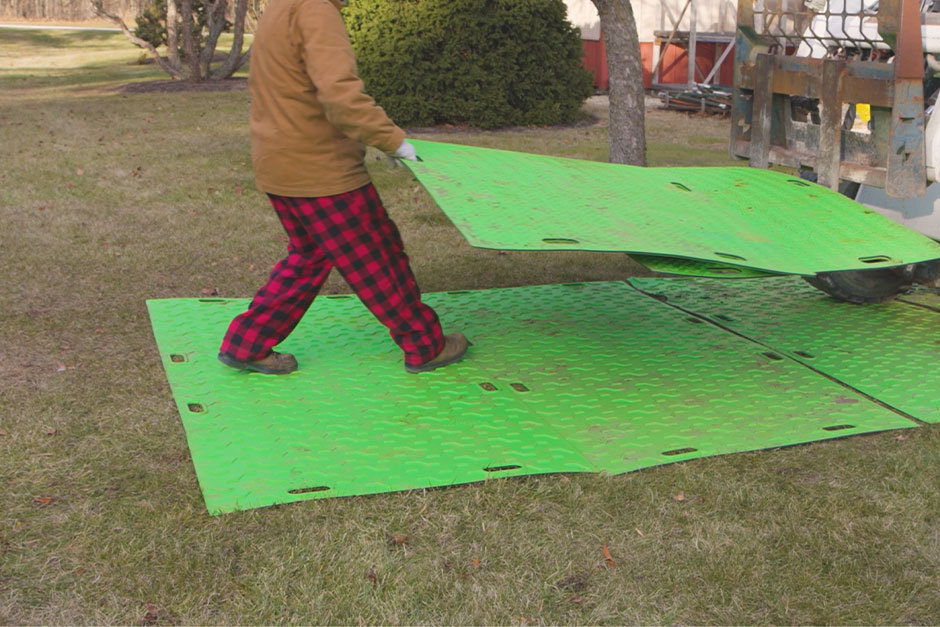
- Panels should be placed end to end with edges touching
- Slight overlaps are acceptable and preferable to gaps
- At direction changes, angle panels to maintain continuous surface
- Use 2×8 panels to fill gaps at the edges of direction changes
The Retrieval Advantage
One often-overlooked advantage of panel-based road mats over other access solutions: retrieval is as fast as deployment. Panels come up clean, stack quickly, and go back in the truck. There’s no reclaimed gravel to haul, no temporary road to decommission.
This efficiency matters especially on jobs where access must be opened and closed repeatedly throughout the project.
Frequently Asked Questions
Q: Can road mats be used on slopes for heavy equipment access?
A: Yes, with attention to slope angle and surface conditions. BAM! mats provide traction on slopes up to approximately 15 degrees for most equipment types. Steeper grades may require additional anchoring. Call 888-870-8158 to discuss your specific slope application.
Q: How many road mats do I need for a 50-foot equipment access route?
A: A 50-foot double-column route requires approximately 14 panels (50 ft / 8 ft per panel x 2 columns = 13 panels, rounded up). Add panels for the staging zone at the far end.
Q: Do BAM! mats interlock or connect to each other?
A: BAM! mats use an interlocking tread design that keeps stacked panels aligned during transport and storage. For deployed routes, panels are placed edge to edge. The mats don’t mechanically connect, but the dual-tread pattern prevents them from shifting during use.
Q: What’s the best way to handle equipment turns on a mat access route?
A: Add additional panels at any turning point where equipment will pivot. Turning creates lateral forces that can shift panels at the edges of the route. Extra coverage provides a buffer zone and prevents equipment from overrunning the mat edge during turns.
Build the Route Before You Need It
The most common mistake with heavy equipment access is laying mats after problems have started—after the first equipment pass has already damaged the surface, or after ground conditions have deteriorated.
Build the route first. Before the equipment moves. Before conditions change. The job goes better, the site stays cleaner, and the client sees a professional operation from day one.
Explore BAM! road mats at bamgroundpro.com/products. Find your nearest distributor at bamgroundpro.com/where-to-purchase. Contact us at bamgroundpro.com/contact-us, call 888-870-8158, or email msheridan@alliedplastics.com. Work cleaner. Work safer. Pro’s choose BAM!